


From the Field to the Dashboard – Built by Experts, for Experts.
Discover What's Really Happening in the Steel Industry
Use the AI-powered search engine to analyze production activity, market trends, and news faster than ever before.
Try the Free AI Search EnginePositive Steel Market Sentiment in Europe: Jindal Steel’s Acquisition Efforts and Activity Shifts
Recent developments in the European steel market reflect a positive sentiment, driven particularly by acquisition activities surrounding major players. The article “Jindal Steel back in the running to acquire ADI” clearly indicates renewed interest in Acciaierie d’Italia (ADI) as Jindal Steel articulates an ambitious industrial plan to decarbonize operations. These discussions correlate with corresponding satellite-observed activity shifts at ADI’s facilities that reveal operational challenges, notably a court ruling that may suspend production at the Taranto plant. Additionally, Flacks Group’s intent to bid for thyssenkrupp Steel division, as cited in “Flacks Group Eyes Placing Bid on thyssenkrupp Steel Division If Talks With Jindal Steel Fall Through,” adds further dynamics to the landscape but lacks direct impact on current activity levels.
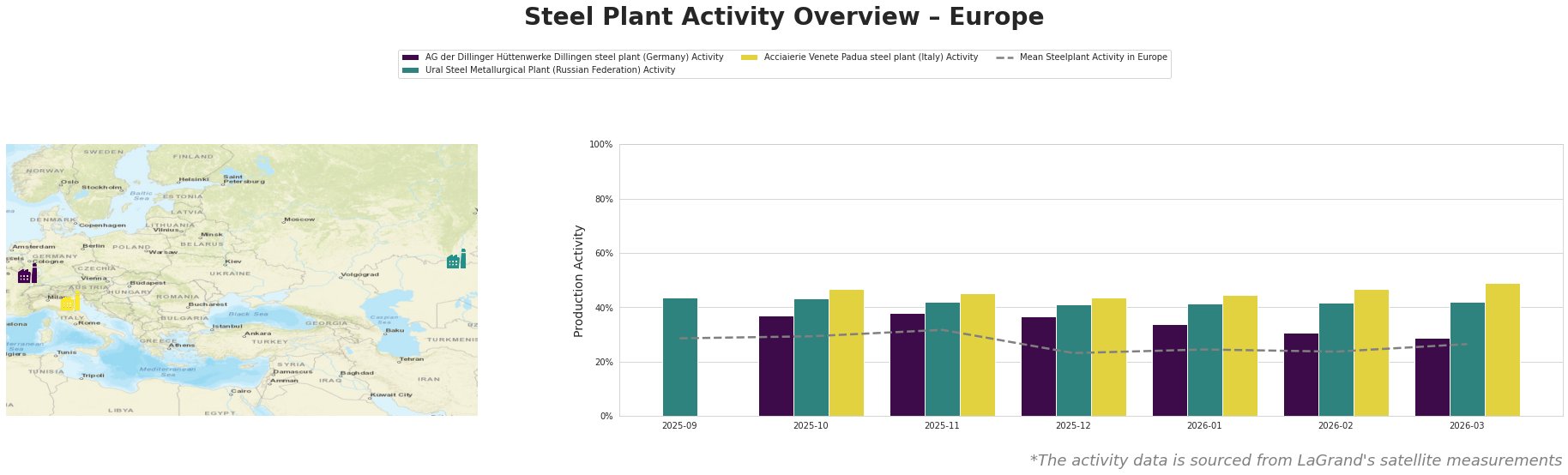
The observed activity data indicates that AG der Dillinger Hüttenwerke Dillingen has experienced a decline to 29% by March 2026, a notable drop when compared to its high of 37% in October 2025. This does not draw a direct connection to any of the recent news articles, thereby indicating potential internal operational issues. Conversely, the Ural Steel Metallurgical Plant maintained stable levels around 42%, likely benefiting from steady market demand or efficient operations, although this too cannot be explicitly linked to the current news context. Notably, Acciaierie Venete Padua has shown a positive uptick, reaching 49% activity, parallel to rising interest around ADI’s acquisition efforts, suggesting enhanced market competitiveness.
Potential supply disruptions are primarily tied to ADI’s operational challenges linked to court rulings affecting its Taranto plant, highlighting the need for vigilance among buyers regarding delivery timelines in the Italian market. Steel procurement professionals should consider prioritizing alternative suppliers like Ural Steel or Acciaierie Venete to mitigate any risks stemming from ADI’s uncertainties. Furthermore, monitoring the outcome of Jindal’s bid could impact overall capacities as new ownership could lead to shifts in operational strategies across affected plants.
In conclusion, while the overall market outlook is positive, stakeholders need to strategically position their procurement approaches based on individual plant activity levels alongside broader acquisition developments within the industry.