


From the Field to the Dashboard – Built by Experts, for Experts.
Discover What's Really Happening in the Steel Industry
Use the AI-powered search engine to analyze production activity, market trends, and news faster than ever before.
Try the Free AI Search EnginePositive Momentum in the European Steel Market: Supply Constraints Drive Price Increases
The European steel market is witnessing a positive shift, driven primarily by rising hot-rolled coil (HRC) prices amid reduced production and minimal imports. Recent observations explained in “European HRC prices continue to rise as factories reduce production amid deteriorating import forecasts” (2026-03-13) and “European coil and green steel round-up: EU coil prices continue upward trend as costs and import barriers bite” (2026-03-15) indicate a notable correlation between these articles and increased production activities at select plants observed through satellite data.
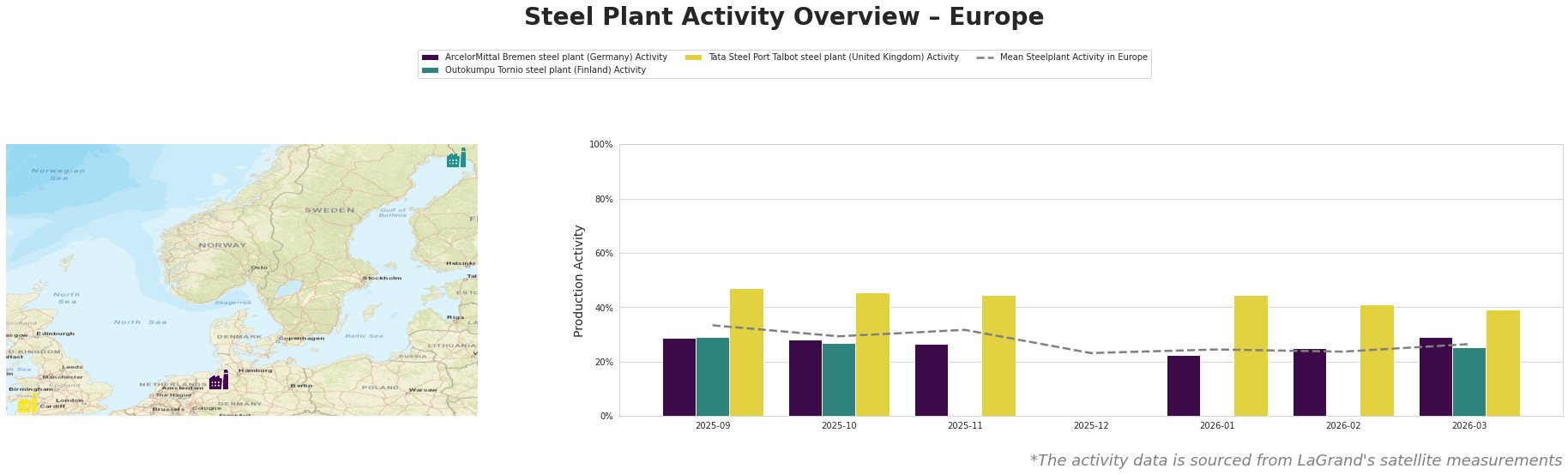
The ArcelorMittal Bremen steel plant displayed stable activity, peaking at 29.0% for March 2026, aligning with the increased market prices mentioned in “European HRC prices continue to rise as factories reduce production amid deteriorating import forecasts.” In contrast, activity levels at the Outokumpu Tornio steel plant remained relatively low, indicating a decline in production capacity, but no direct link could be established with the news articles provided.
The Tata Steel Port Talbot steel plant demonstrated slightly decreasing activity, with percentages fluctuating near 39.0%, hovering below the mean activity levels across Europe. These developments suggest that while domestic capacity may face sporadic pressures, overall production remains resilient against the backdrop of rising prices.
The interplay between increased pricing pressures and limited import opportunities, as highlighted in “European HRC prices are rising, but weak demand and virtually zero imports are holding back activity” (2026-03-13), calls for strategic procurement actions. Steel buyers are advised to prioritize sourcing from reliable domestic suppliers like ArcelorMittal, as rising freight costs and geopolitical tensions threaten volatility in import markets.
In conclusion, monitoring shifts in production levels, particularly at ArcelorMittal Bremen and Tata Steel Port Talbot, will be crucial for anticipating supply fluctuations. Steel buyers should secure contracts promptly while negotiating prices, considering the limitations on imports and steady price increases.