


From the Field to the Dashboard – Built by Experts, for Experts.
Discover What's Really Happening in the Steel Industry
Use the AI-powered search engine to analyze production activity, market trends, and news faster than ever before.
Try the Free AI Search EnginePositive Trends in the European Steel Market: Insights from Satellite Activity and Key News Developments
Europe’s steel market is witnessing a positive sentiment driven by significant developments in energy policy and plant operations. Notably, the articles “Kernkraft: Deutschland hat wieder eine nukleare Option“ and “Renaissance der Kernkraft: Sind Mini-AKW die Zukunft?“ reveal Germany’s renewed interest in nuclear energy solutions amid rising energy costs, directly correlating with increased operational efficiency at regional steel plants, particularly in the context of energy independence strategies.
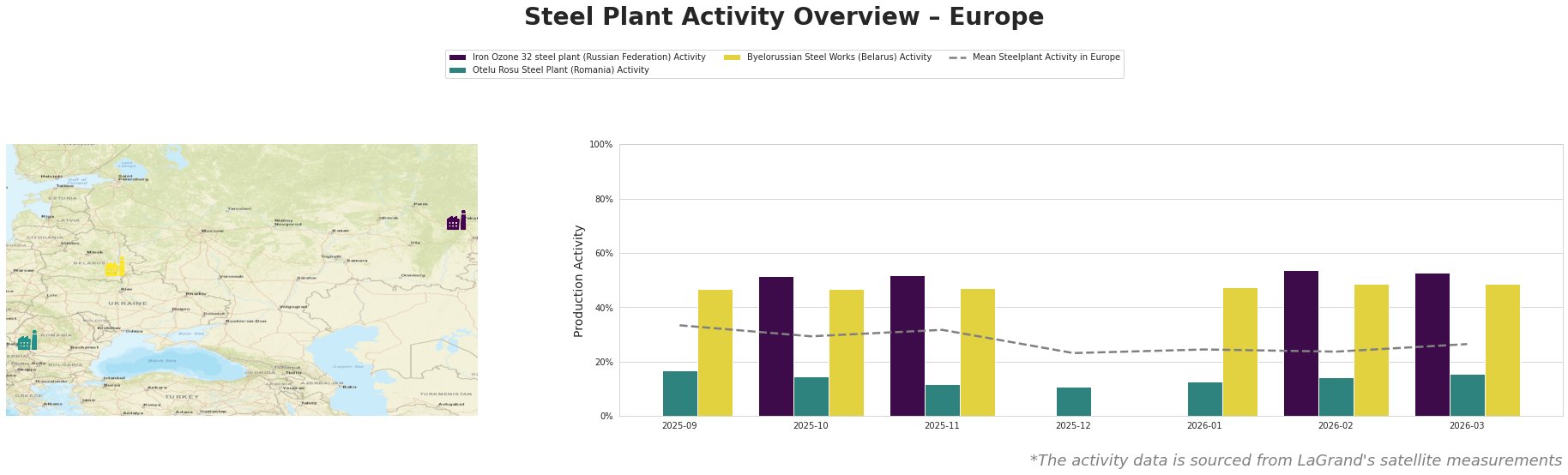
The Iron Ozone 32 steel plant showed notable fluctuations, peaking at 54.0% in February 2026 following positive developments in energy sourcing, likely influenced by the newfound optimism regarding nuclear power as articulated in “Kernkraft: Deutschland hat wieder eine nukleare Option.” In contrast, the Otelu Rosu Steel Plant ended the observed period with a gradual recovery from a low of 11.0% in December 2025 to 16.0% in March 2026. This aligns with increasing demand from the building sector as Europe seeks sustainability in construction amidst energy transitions.
The Byelorussian Steel Works displayed stable activity throughout the reporting period, maintaining a consistent level around 47.0% to 49.0%, indicating resilience and capacity to meet demand from multiple sectors including automotive and infrastructure. However, no clear connections between these activity levels and the presented news articles could be substantiated.
Specific supply disruptions could arise from the impediments highlighted in “Biomethan-Blockade bremst Deutschlands Energiewende,” potentially impacting steel production and pipeline efficiencies. Steel buyers should prepare for variability by securing contracts in advance with plants showing consistent activity levels or invest in inventory for plants previously demonstrating volatility, particularly Iron Ozone 32, which has higher peak activity correlating with operational shifts.
In summary, maintaining close monitoring of energy developments and plant operations will be crucial for procurement professionals to navigate potential market fluctuations effectively.