


From the Field to the Dashboard – Built by Experts, for Experts.
Discover What's Really Happening in the Steel Industry
Use the AI-powered search engine to analyze production activity, market trends, and news faster than ever before.
Try the Free AI Search EngineAsia’s Steel Market Faces Severe Disruptions Amid Rising Energy Costs
The steel industry in Asia is currently experiencing a very negative sentiment due to escalating energy costs and geopolitical tensions. Recent announcements like the IEA to make 400mn bl oil available from stocks have been linked to significant shifts in plant activities; however, no direct relationships can be established with the observed activity levels in the region’s key steel plants.
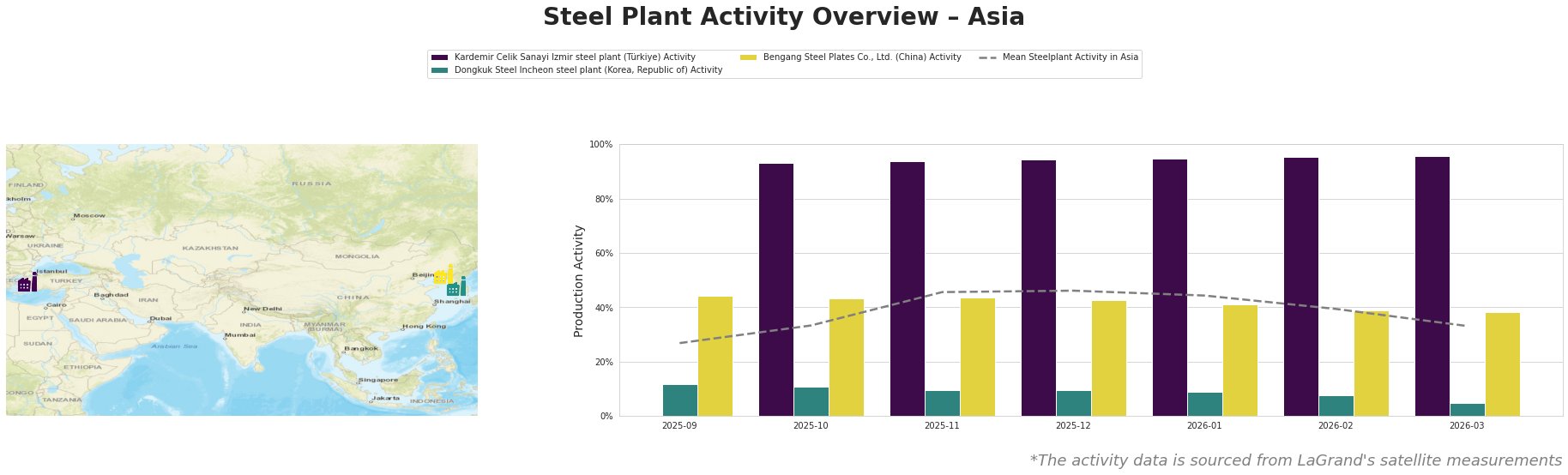
The Kardemir Celik Sanayi Izmir steel plant has shown remarkable resilience, peaking at 96% activity in March 2026. The plant operates an Electric Arc Furnace (EAF) with a production capacity of 1.25 million tonnes of crude steel and predominantly serves sectors like automotive and construction. However, the broader market context does exhibit concerns regarding energy supply challenges highlighted by the IEA’s recent oil stock release, yet no direct connection has been established with its operational shifts.
The Dongkuk Steel Incheon steel plant, which holds 2.2 million tonnes capacity also operating via EAF, has seen a disastrous slip to 5% activity in March 2026. This decline corresponds with fears of increased energy prices after the IEA to make 400mn bl oil available from stocks announcement, though the activity reduction does not directly correlate with any specific action or event.
Bengang Steel Plates Co., Ltd. has maintained relatively stable yet low activity, remaining at 38% activity by March 2026, reflecting sustained operational constraints despite potential moderation in upstream energy costs as per IEA’s planned stock release. The plant underpins key segments such as automotive plates and benefits from an integrated production methodology.
The recent geopolitical tensions, especially affecting oil supplies from the Strait of Hormuz, suggest looming supply disruptions for steel production in Asia.
Procurement professionals are advised to prepare for potential supply shortages, particularly from Dongkuk Steel, which is heavily impacted by both energy cost escalations and reduced activity levels. It may benefit buyers to consider alternative suppliers while monitoring the stability of energy-related developments impacting this critical supply chain. Strategic stockpiling ahead of anticipated production limits will also be prudent in maintaining operational continuity.