


From the Field to the Dashboard – Built by Experts, for Experts.
Discover What's Really Happening in the Steel Industry
Use the AI-powered search engine to analyze production activity, market trends, and news faster than ever before.
Try the Free AI Search EngineItaly’s Steel Industry Faces Challenges: Activity Declines Amidsto ETS Suspension Calls
Recent developments in the Italian steel sector signal a mounting crisis, heavily influenced by proposed changes to the European emissions trading system (ETS). Articles titled “Italy to ask for immediate EU ETS suspension“ and “Federacciai seeks suspension of ETS for Italy“ illuminate the pressing concerns of rising electricity costs linked to the ETS, correlating with notable drops in steel plant activity observed via satellite data.
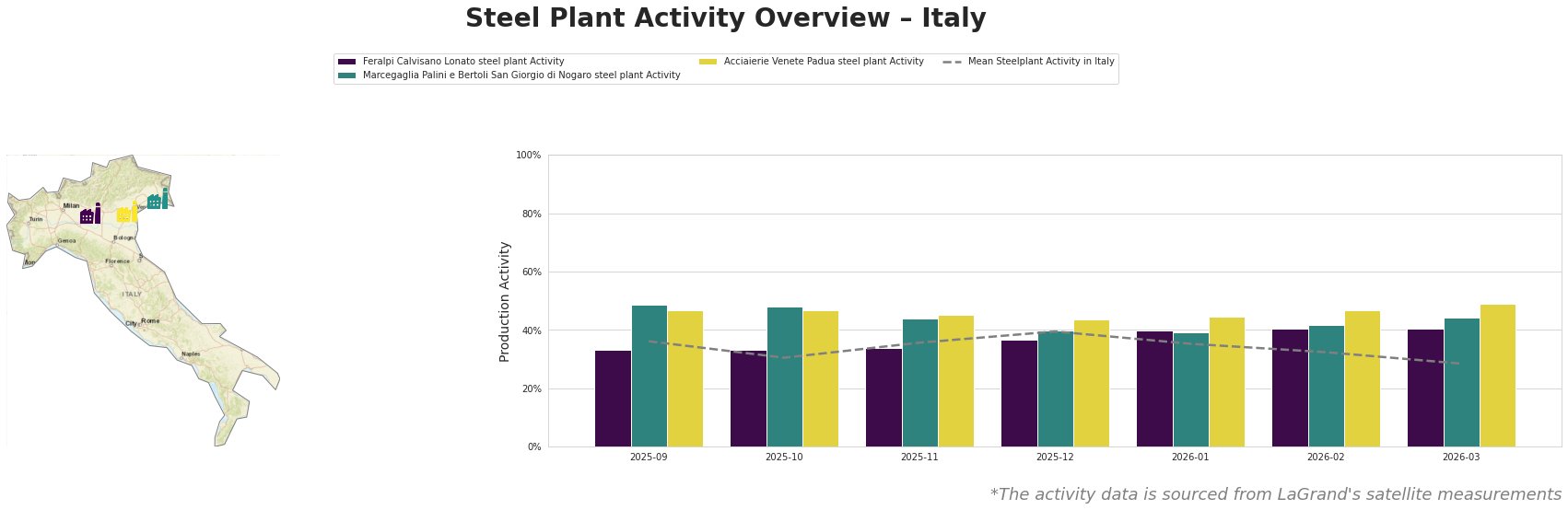
Steel plant activity has shown a downward trend, with the mean activity declining from 36.0% in September 2025 to 28.0% in March 2026, reflecting a broader sentiment of concern within the sector. Specific plants, such as Acciaierie Venete Padua, have experienced fluctuations; it peaked at 49% in March but has a cumulative decline that aligns with concerns raised in “Federacciai seeks suspension of ETS for Italy.”
Feralpi Calvisano Lonato demonstrates consistent performance, maintaining activity around 40% but failing to escalate amid these sector trends. Notably, Marcegaglia Palini e Bertoli observed a high of 49% earlier in the timeline, subsequently experiencing declines that reflect negative market sentiment substantiated by disruption discussions surrounding the ETS.
The call for an ETS suspension, as articulated by Prime Minister Giorgia Meloni and Antonio Gozzi, President of Federacciai, directly connects to the financial viability of steel production under the burden of soaring energy costs. Specifically, Meloni’s statement emphasized potential complications regarding electricity pricing, correlating with the observed activity declines across plants.
Given these developments:
- There is a heightened risk of supply disruptions stemming from reduced operational outputs, particularly at sites like Acciaierie Venete Padua, where reliance on stable energy pricing is crucial for maintaining production levels.
- Steel buyers are advised to closely monitor developments regarding the ETS adjustments and consider securing procurement ahead of possible market shocks. The anticipated suspension may provide temporary relief, yet the ultimate impact on price and availability remains uncertain.
- Careful consideration should be given to establish contracts that allow for flexibility amid market volatility driven by regulatory changes and energy pricing.
Effective management of supply chains and procurement strategies will be paramount as the industry navigates this tumultuous landscape.