


From the Field to the Dashboard – Built by Experts, for Experts.
Discover What's Really Happening in the Steel Industry
Use the AI-powered search engine to analyze production activity, market trends, and news faster than ever before.
Try the Free AI Search EngineAsia’s Steel Market in Crisis: Activity Plummets Amidst Rising Oil Concerns
Recent developments in Asia’s steel market underscore a grim outlook as plant activities show a marked decline due to external pressures. Notably, the news article “US-Iran war: Latest news“ highlights the severe impact of the US-Iran conflict and fluctuating crude oil prices on overall market conditions. This sentiment is corroborated by diminishing satellite-observed activities across prominent steel plants in the region.
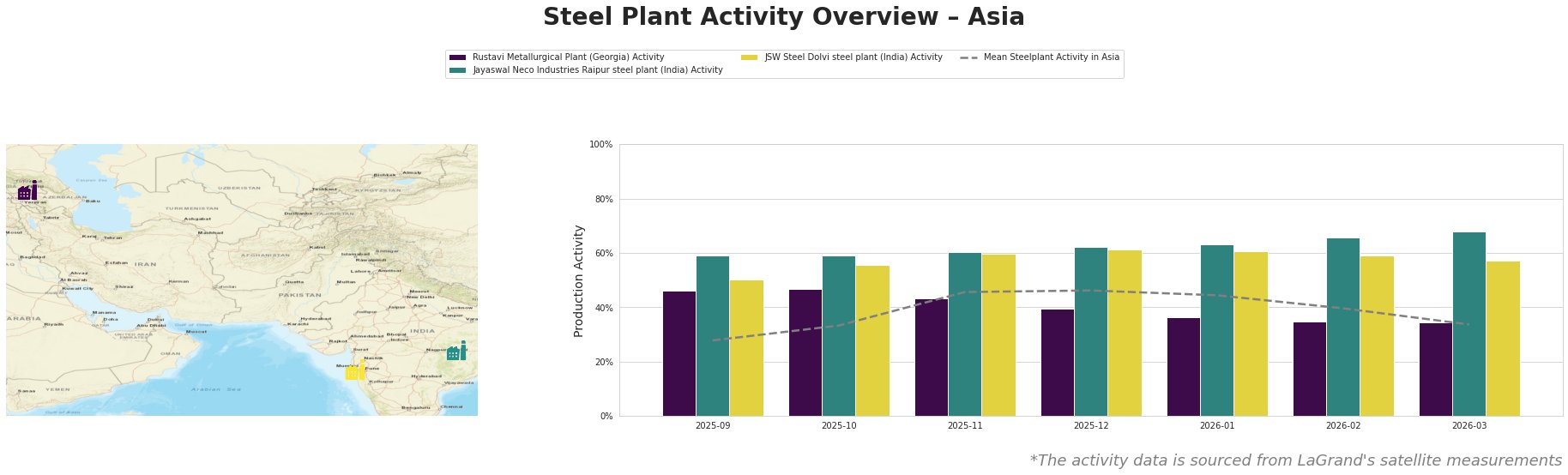
Over the last few months, the mean activity level across all observed sites in Asia displays a downward trend, falling from 46.0% in November to 34.0% in March 2026. The Rustavi Metallurgical Plant has decreased its activity from 46.0% to 35.0%, aligning with overall market instability without an explicit connection to external occurrences. Meanwhile, the Jayaswal Neco Industries Raipur steel plant has managed to maintain higher levels around 60% but saw a slight decrease recently, showing variability likely tied to demand fluctuations from the conflict as noted in “US-Iran war: Latest news”. The JSW Steel Dolvi plant also experienced a fall from 60.0% in November to 57.0% in March, which may reflect the same economic pressures impacting oil supply.
The overall declining activity raises concerns about potential supply disruptions. With crude oil prices remaining volatile, as highlighted in “Crude futures drop below $90/bl“, the rising costs and unpredictability could impose operational challenges for these plants as materials become increasingly expensive. Given these factors, steel procurement professionals should consider sourcing options that are insulated from these price fluctuations, prioritizing contracts that lock in pricing before further conflicts escalate.
In light of this analysis, it’s recommended that procurement teams closely monitor specific plants’ operational capacity, particularly Jayaswal Neco and JSW Steel, which show higher resilience despite market challenges. Strategic stockpiling of steel products should also be considered, given the recent downward activity trends and their potential impact on future availability.