


From the Field to the Dashboard – Built by Experts, for Experts.
Discover What's Really Happening in the Steel Industry
Use the AI-powered search engine to analyze production activity, market trends, and news faster than ever before.
Try the Free AI Search EngineSevere Disruptions in Kuwait’s Steel Market Amid Ongoing Middle East Conflict
Kuwait’s steel market faces unprecedented challenges as the ongoing conflict in the Middle East disrupts key oil exports, impacting the steel production landscape. The news articles “Kuwait cuts crude output after Hormuz disruption“ and “Kuwait cuts crude output on Hormuz disruption: Update“ highlight significant reductions in oil output and refinery operations, which are expected to affect the supply chains linked to steel production due to the reliance on oil-derived energy inputs for steel mills. As evidenced by satellite data, significant drops in activity levels at steel plants correlate with these developments, indicating a very negative market sentiment.
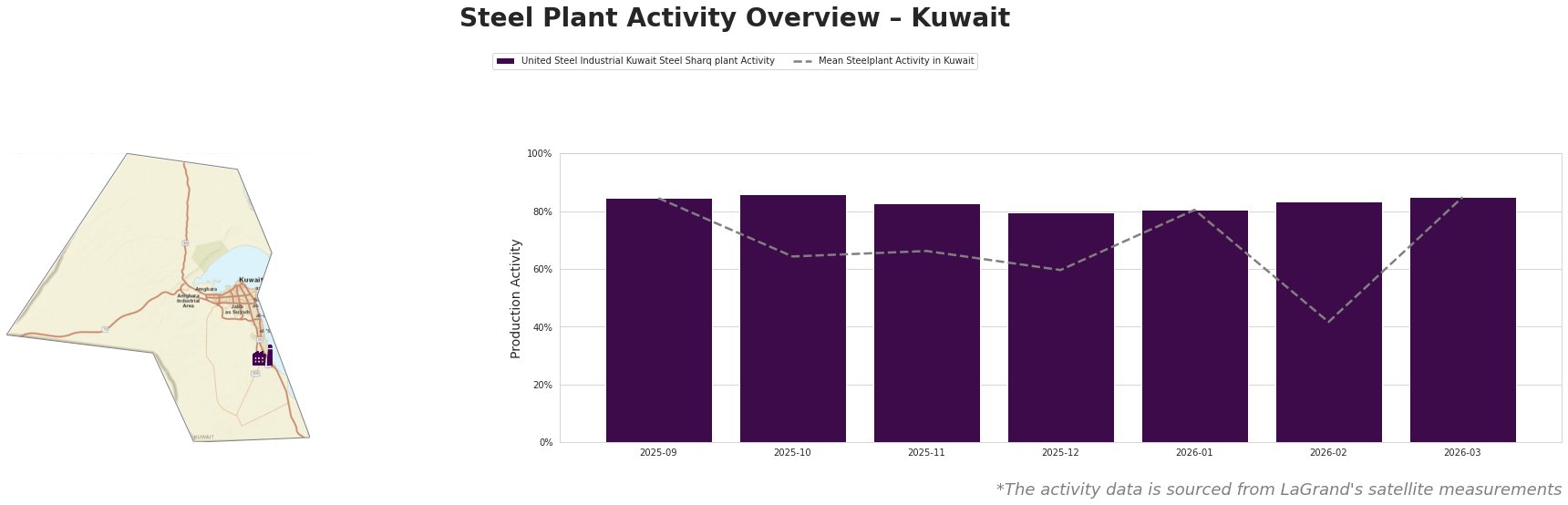
The United Steel Industrial Kuwait Steel Sharq plant’s activity has shown notable fluctuations, peaking at 86% in October 2025 and falling to 42% in February 2026. This drop aligns with rising instability and conflicts in the region, as discussed in the articles regarding crude output reductions. The mean activity across observed plants fell to 42% in February, possibly linking to KPC’s precautionary measures mentioned in the “Kuwait cuts crude output on Hormuz disruption: Update.” A subsequent increase to 85% in March does not directly connect to any news, suggesting short-term volatility might be due to market adjustments rather than fundamental improvements.
At the United Steel Industrial Kuwait Steel Sharq plant, produced primarily through Electric Arc Furnace (EAF) technology, the fluctuating activity trends mirror the broader instability in oil exports and refinery operations. The plant’s productivity is heavily influenced by energy availability, affected by oil export disruptions highlighted in the news. Despite a recovery in March, it remains vulnerable due to the broader regional scenario.
Impacted by the ongoing conflict, supply chain stability in Kuwait may face further disruptions. With the Kuwaiti oil company implementing stringent measures, it is prudent for steel buyers to reconsider procurement strategies. Specifically, buyers should:
- Anticipate potential shortages: Proactively sourcing from alternate markets may mitigate risks associated with local supply disruptions due to ongoing regional instability.
- Monitor price trends closely: With confirmed reductions in output like those noted in the articles, there is potential for price increases; strategic buying ahead of disruptions may provide cost advantages.
- Evaluate local supplier reliability: Establishing relationships with suppliers not dependent on the Strait of Hormuz may provide operational buffer during supply interruptions.
The current market signals a very negative sentiment, underscoring the necessity for immediate, informed actions to safeguard procurement strategies amid escalating regional conflicts.