


From the Field to the Dashboard – Built by Experts, for Experts.
Discover What's Really Happening in the Steel Industry
Use the AI-powered search engine to analyze production activity, market trends, and news faster than ever before.
Try the Free AI Search EnginePositive Sentiment in the European Steel Market Amid Shifting Legislative Landscape
Recent developments in Germany, particularly concerning climate legislation and energy supply, have positively influenced the European steel market. Significant changes in activity levels at various steel plants, notably reflected in the articles “German heating proposals ‘jeopardise climate targets’” and “Gebäudemodernisierungsgesetz Guter Ansatz oder zu kurz gedacht?”, correlate to observable trends in plant operations, though direct connections remain nuanced.
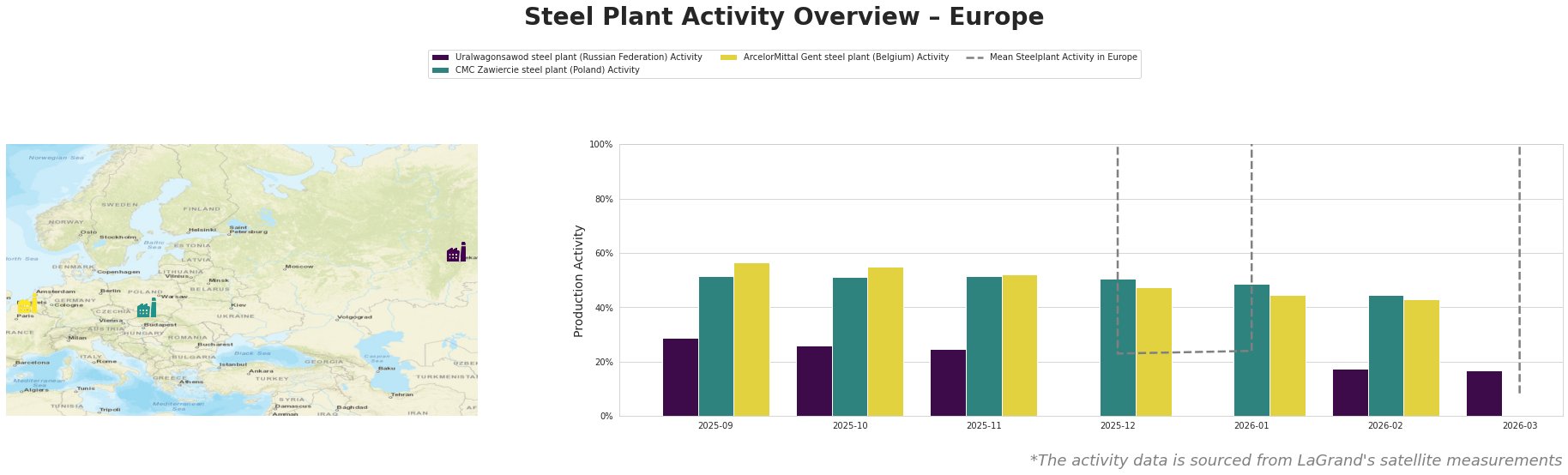
The CMC Zawiercie plant’s activity remained largely stable around 50%, reflecting resilience amidst fluctuating trends, whereas ArcelorMittal Gent consistently showcased higher activity levels, peaking at 57% in September 2025. Conversely, Uralwagonsawod’s notable decline to 17% in February 2026 corresponds with a broader downward trend and may indirectly relate to the political discussions on gas supply expansion outlined in the article “Deutschland-Blog: Reiche rechnet nicht mit Gasknappheit | FAZ.”
The Uralwagonsawod steel plant, which is primarily engaged in defense sector production, presents an unclear correlation with legislative changes due to its limited data availability. Similarly, it registered a significant drop of 12% in activity from October to February, which may reflect broader economic impacts beyond immediate steel market dynamics.
The CMC Zawiercie steel plant, operating with a capacity of 1,700 ktpa using electric arc furnace technology, showed a slight dip associated with regional energy supply discussions and cost volatility considerations, particularly concerning special fuels referenced in “German heating proposals ‘jeopardise climate targets.’”
ArcelorMittal Gent, an integrated facility with a capacity of 5,000 ktpa, maintained robust activity levels despite the political challenges in the region related to climate policy. Its performance remains a bellwether for the sector, suggesting that investment in efficient technologies and sustainability initiatives pays off against the backdrop of rising regulatory demands.
In light of the observed data and news context:
- Potential supply disruptions may arise primarily from Uralwagonsawod due to dwindling activity levels, urging buyers to monitor developments closely.
- Procurement actions should prioritize sources from the ArcelorMittal Gent and CMC Zawiercie plants, which demonstrate a consistent ability to adapt to shifting market demands and political climates.
Overall, strategies focusing on securing supplies from plants exhibiting strong resilience and adaptability are recommended, while vigilance toward legislative impacts on energy supply should be maintained for forecasting future disruptions.