


From the Field to the Dashboard – Built by Experts, for Experts.
Discover What's Really Happening in the Steel Industry
Use the AI-powered search engine to analyze production activity, market trends, and news faster than ever before.
Try the Free AI Search EngineEurope Steel Market Report: Activity Declines Amidst Regulatory Uncertainty – Buyer Alert
In Europe, recent policy developments in Germany have negatively impacted the steel market as evidenced by rising concerns over proposed heating regulations. The articles “German heating proposals ‘jeopardise climate targets’“ and “Gebäudemodernisierungsgesetz Guter Ansatz oder zu kurz gedacht?“ illustrate a potential offset to climate targets, resulting in increased emissions and costs. These issues correspond with observable declines in the activity levels of European steel plants, particularly after the finalization of the new regulations, signaling a challenging environment for steel procurement.
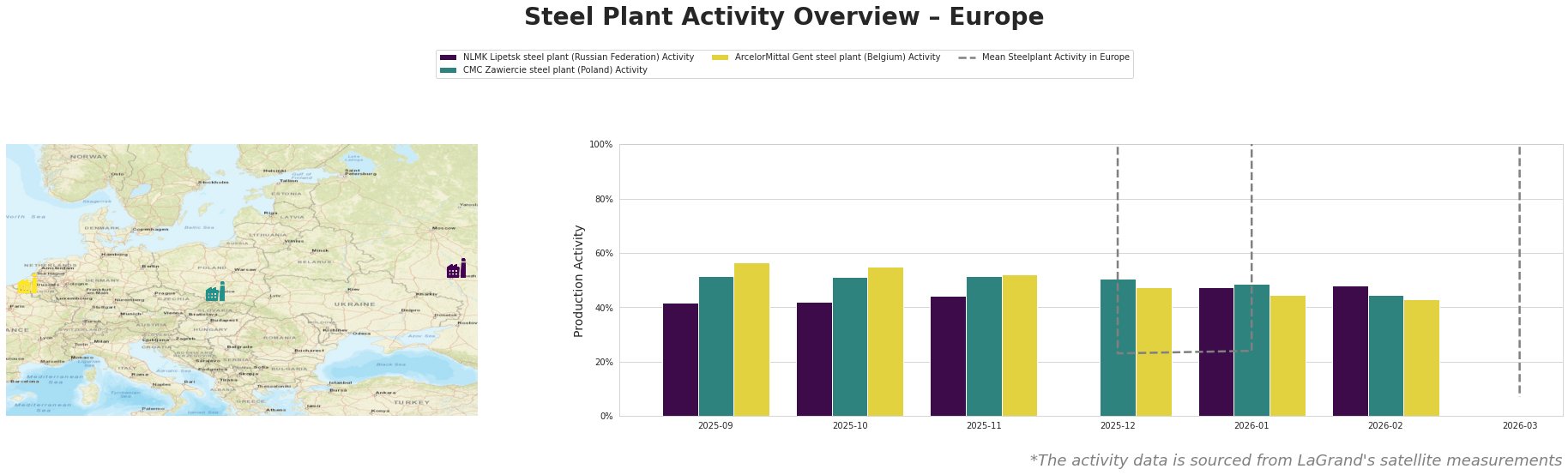
Across the observed timeframe, the mean activity level has sharply decreased, plummeting from nearly 13 billion at its peak to just 7.0 in March 2026. Specifically, NLMK Lipetsk’s activity remained relatively stable between 42% and 48% until the downward trend escalated in December, coinciding with increased scrutiny of regulatory risks highlighted in “Was tun im Heizungskeller?“.
NLMK Lipetsk, with a crude steel capacity of 13,200 tons and employing an integrated process, saw its activity drop notably from 44.0% in November 2025 to 48.0% in January 2026, closely aligning with the regulatory concerns affecting energy and emissions noted in the recent news. This highlights the uncertainty surrounding the legal landscape and its impacts on operational output.
CMC Zawiercie, utilizing an Electric Arc Furnace (EAF) with a modest capacity of 1,700 tons, showed slight fluctuations and ended February 2026 at 45% activity after an initial high of 52%. The transition challenges for gas heating methods discussed in the legislative articles suggest potential long-term impacts on overall production efficiency in regions relying on local EAF operations.
ArcelorMittal Gent, with a diversified production capability, witnessed a more pronounced decline from 57% to 43% in activity levels from September to February. The implications of the new Building Modernization Law directly challenge not only operational efficiency but also cost structures, which may lead to further output cuts if the industry fails to pivot rapidly to new energy solutions.
Given the present regulatory environment and recent activity declines, steel buyers are advised to:
-
Consider immediate procurement from more stable operations such as NLMK Lipetsk, as their relatively higher activity levels suggest a stronger output potential compared to competitors.
-
Evaluate procurement schedules closely, factoring in the expected disruptions tied to regulatory changes as highlighted in “German heating proposals ‘jeopardise climate targets’”. Early contracts may mitigate potential supply shortages.
-
Monitor regional market shifts actively, particularly regarding emerging compliance costs from changes under the Building Modernization Laws, as these will likely affect pricing strategies throughout the supply chain.
Overall, remaining agile in response to these dynamic shifts could prove critical for sustaining operational efficacy in purchasing strategies.