


From the Field to the Dashboard – Built by Experts, for Experts.
Discover What's Really Happening in the Steel Industry
Use the AI-powered search engine to analyze production activity, market trends, and news faster than ever before.
Try the Free AI Search EngineStrong North American Steel Market Sentiment Amid Shifting Tariff Policies
The North American steel market exhibits a very positive sentiment as recent satellite data highlights significant active trends in major steel plants. Following the article “Trump upbeat on economy despite tariff setback“, President Trump’s introduction of a new 10% global tariff aims to revitalize domestic steel production after the Supreme Court’s limitations on his tariff powers, as noted in “Supreme Court blocks Trump tariffs—but hands him a smarter path forward.” The satellite observations corroborate a marked increase in operational activity levels in response to these economic policies.
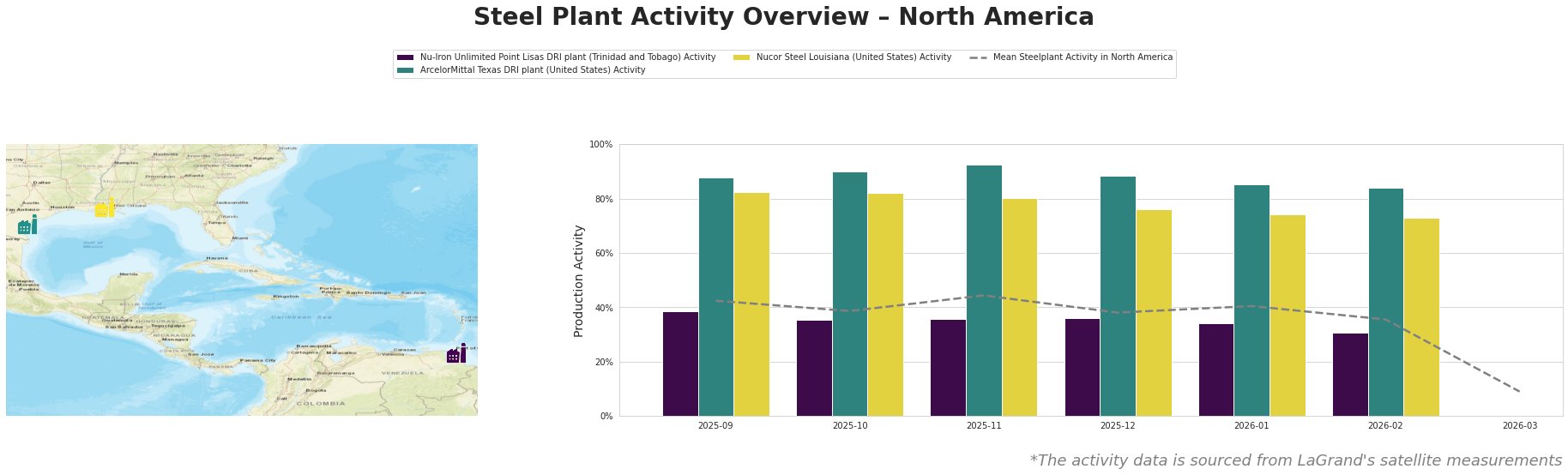
Nu-Iron Unlimited Point Lisas DRI Plant has experienced sustained activity at around 38%-36% from September to December 2025, before dropping to 31% in February 2026, with no direct connections to the news articles establishing causation for this decline.
ArcelorMittal’s Texas DRI Plant witnessed a peak at 92% in November 2025, while remaining above 80% until February 2026. The plant’s robust output aligns with Trump’s recent tariff announcements, indicating an optimistic production outlook. However, by March 2026, the activity level plunged to 9%, without any directly attributable news events.
Nucor Steel Louisiana showed a steady decline to 73% by February 2026 after peaking at 82% from September to November 2025, highlighting volatility potentially linked to market reactions surrounding tariff policy uncertainty.
The observed variance suggests potential supply disruptions, primarily at ArcelorMittal, due to decreasing activity levels. Steel buyers are advised to closely monitor ongoing tariff developments and their implications on supply chains. Given the recent tariff strategy outlined by Trump, it may be prudent to secure orders proactively to mitigate risks of production delays, particularly from plants showing significant fluctuations in activity. Steel procurement professionals should prepare for potential challenges in sourcing, especially with rising tariffs possibly impacting imported materials significantly.