


From the Field to the Dashboard – Built by Experts, for Experts.
Discover What's Really Happening in the Steel Industry
Use the AI-powered search engine to analyze production activity, market trends, and news faster than ever before.
Try the Free AI Search EngineSouth America Steel Market Report: Activity Plummets Amid US Tariff Uncertainty
The steel market in South America is currently facing significant challenges due to heightened uncertainty stemming from international tariff disputes, particularly involving the United States. Recent developments, including “Zollstreit und Handelsabkommen: „Die Basis für den Deal ist nicht mehr gegeben“ – EU-Abgeordneter fordert Neuverhandlung mit USA“ and “US-Zollpolitik EU lenkt in Richtung Konfrontationskurs“, indicate a destabilization in trade relations that has contributed to decreased operational activity among regional steel plants.
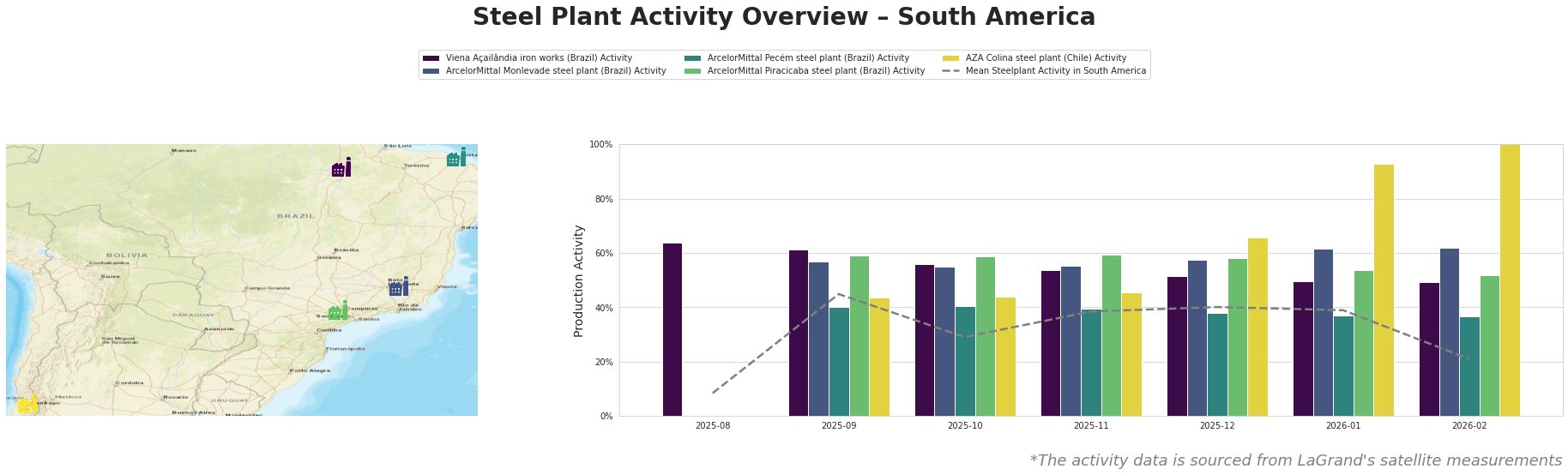
The overall mean activity level across South America has plummeted from 45.0% in September 2025 to a mere 21.0% by February 2026, reflecting a downward trend that correlates with increasing tariff tensions.
At the Viena Açailândia iron works, activity slightly decreased by 15% from September (61.0%) to February (49.0%). This drop aligns with the lack of clarity in future trade conditions as emphasized in the news articles.
The ArcelorMittal Monlevade plant has significantly increased activity to 62.0% in February from a steady 55.0% range in prior months, suggesting a brief recovery phase, yet this improvement is still overshadowed by broader market instability.
Meanwhile, ArcelorMittal Pecém and Piracicaba showed overall negative trends, with activity falling to 37.0% for both plants, demonstrating vulnerability to the destabilizing tariffs discussed in “Zollstreit und Handelsabkommen”.
The AZA Colina steel plant displayed a reversal in trend, peaking at 100% activity in February but remains at risk of instability should trade conditions worsen, highlighting the volatility inherent in the current market as indicated in “US-Zollpolitik EU lenkt in Richtung Konfrontationskurs”.
In light of these assessments, steel buyers and analysts should focus on the following procurement actions:
-
Diversify Supply Chains: Engage with multiple suppliers across different regions to mitigate the risk of potential supply disruptions as evidenced by falling activity levels in several key plants.
-
Commit to Short-Term Contracts: Given the current market volatility, seeking shorter procurement contracts may help steel buyers adapt more swiftly to evolving trade realities and pricing structures resulting from tariff changes.
-
Prioritize Local Sourcing: Especially from plants like AZA Colina that show unexpected resilience. Their peak activity level may present an opportunity to secure favorable contracts before potential downturns.
The steel market in South America is currently navigating a highly negative environment shaped by external trade relations, with various plants responding differently to the broader crisis. Careful sourcing strategies should be employed to mitigate risks associated with supply disruptions.