


From the Field to the Dashboard – Built by Experts, for Experts.
Discover What's Really Happening in the Steel Industry
Use the AI-powered search engine to analyze production activity, market trends, and news faster than ever before.
Try the Free AI Search EnginePositive Trends in Italy’s Steel Market Amid Rebar Price Adjustments
Italy’s steel market is witnessing a nuanced scenario, with rebar prices expected to decline due to slow consumption as highlighted in the articles “Italian rebar prices seen weakening on slow consumption“ and “Italian rebar prices are declining due to low consumption.” This is mirrored by satellite observations indicating recent drops in activity levels at several prominent steel plants, underscoring the active link between pricing trends and production shifts, particularly related to construction delays from adverse weather.
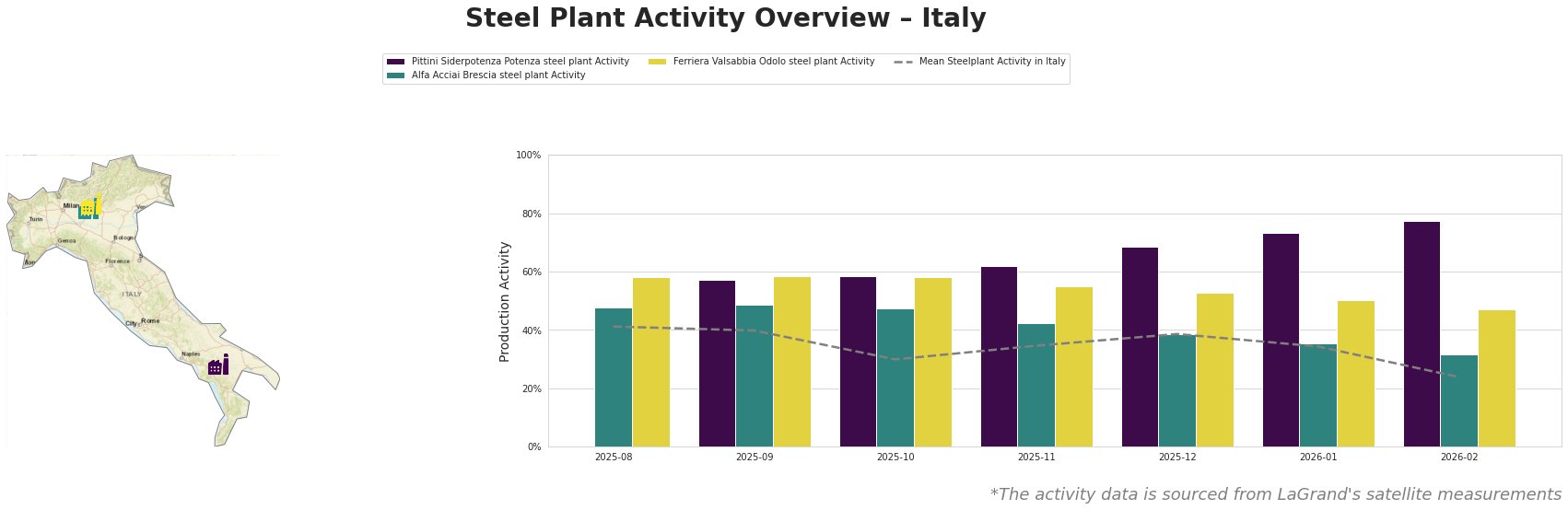
Pittini Siderpotenza plant activity increased to 78% in February 2026, contrasting with the overall downward trend. This spike does not align with the recent news about price reduction, indicating that Pittini may be boosting production to compensate for lowered demand elsewhere. In contrast, Alfa Acciai Brescia saw a decline to 32%, reflecting the impacts of reduced construction activities as reported. Ferriera Valsabbia’s activity at 47% confirms a similar downturn, suggesting that the ongoing rain and diminished private residential construction contribute to the reduced operation levels highlighted in the articles.
Pittini Siderpotenza, with an electric arc furnace (EAF) capacity of 700 tonnes, serves the building and infrastructure sectors primarily through rebar production. Its recent activity growth correlates with reported instability in rebar prices. However, this positivity may lead to eventual overproduction unless consumption aligns with output levels. Meanwhile, Alfa Acciai Brescia, operating within a 1,700 tonnes EAF capacity, witnessed a substantial decrease, likely reflective of sluggish demand for rebar, reiterating the underlying cause of price drops outlined in “Italian rebar prices extend decline; other markets hold firm.” Ferriera Valsabbia’s operations also suffered, indicating widespread sector-wide challenges despite the range of 900 tonnes capacity for finished rolled products.
As evidenced by these shifts, procurement professionals should consider the following:
– Pittini Siderpotenza’s expanding activity may prompt pricing adjustments; thus, buyers should verify pricing structures.
– Increasing rebar supply could lead to lower prices, prompting buyers to expedite purchases to capitalize on the favorable pricing forecast indicated in recent articles.
– Attention should be given to regional variances in pricing and inventory levels, as the construction slowdown in central Italy might cause localized supply disruptions in the upcoming months.
Strong connections are drawn between market sentiment, supplier activity, and pricing trends in the Italian steel market, offering actionable insights for strategic purchasing decisions.