


From the Field to the Dashboard – Built by Experts, for Experts.
Discover What's Really Happening in the Steel Industry
Use the AI-powered search engine to analyze production activity, market trends, and news faster than ever before.
Try the Free AI Search EnginePositive Outlook for European Steel Market Amid Political Dynamics and Plant Activity Trends
In Europe, a positive sentiment underlies the current steel market, driven by notable shifts in plant activity levels and political developments. The recent news articles, “Rütteln am Klimaziel: Unternehmen und Gewerkschaften fürchten um Jobs und Geschäftsmodelle“ and “Merz will Beziehungen zu Golfstaaten erneuern,” reflect a rising political urgency surrounding job security and economic partnerships, correlating with increased activity in key steel plants.
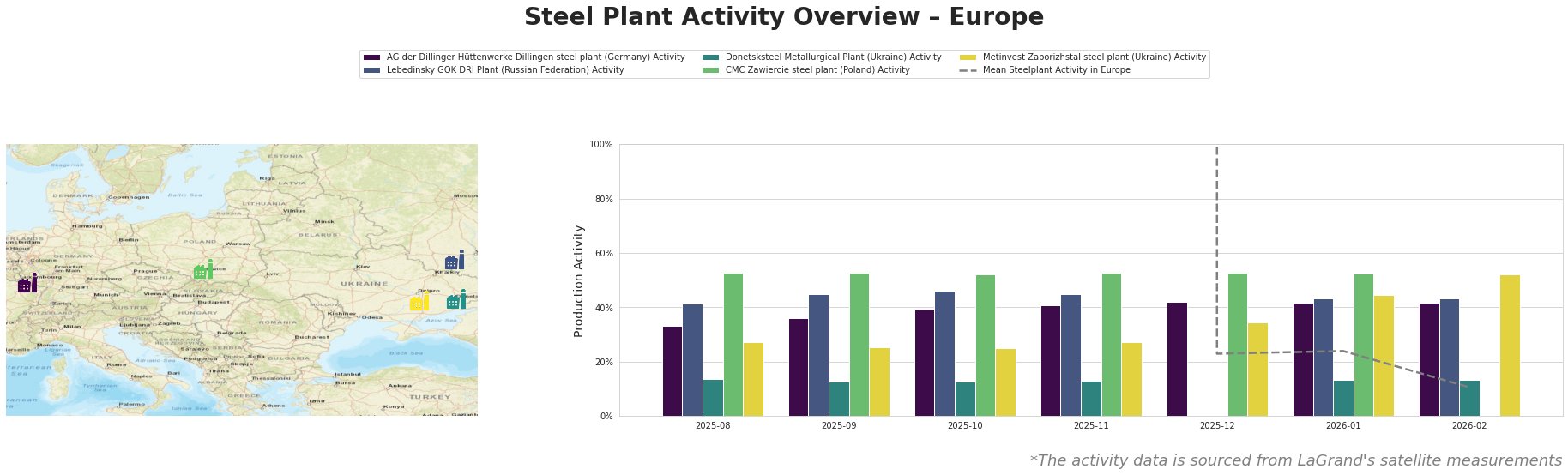
The AG der Dillinger Hüttenwerke Dillingen steel plant has shown a consistent upward trend, achieving a peak of 46% activity in October 2025, aligning with discussions around balancing climate goals with economic stability as mentioned in “Rütteln am Klimaziel”. The Lebedinsky GOK DRI Plant experienced a small decline in observable activity levels but still maintains a significant operational status with 43% observed recently, indicating its capacity to adapt amidst regional political shifts.
On the other hand, the Donetsksteel Metallurgical Plant remains critically hampered, with activity struggling consistently at 13%, reflecting ongoing insecurity and challenges in the region, with no direct connection to recent news. Conversely, the CMC Zawiercie steel plant has maintained stability with a peak at 53%, showcasing resilience within Poland’s favorable market conditions. Finally, Metinvest Zaporizhstal has made strides, recently reaching 52% activity, potentially bolstered by renewed interest in foreign investment as indicated by Friedrich Merz’s push for stronger economic ties with the Gulf states.
Given this landscape, buyers should be aware of specific supply risks, notably from the Donetsk region, where activity stagnation could signal procurement challenges. In contrast, sourcing from the Dillinger Hüttenwerke and Zaporizhstal plants appears promising as they navigate the political arena effectively, thereby sustaining production capabilities. Procurement strategies should focus on these growing suppliers to optimize resource acquisition while remaining vigilant about regional instabilities that could affect supply continuity.