


From the Field to the Dashboard – Built by Experts, for Experts.
Discover What's Really Happening in the Steel Industry
Use the AI-powered search engine to analyze production activity, market trends, and news faster than ever before.
Try the Free AI Search EngineStrong Growth in European Steel Activity Amid ETS Reform Discussions
European steel producers are experiencing a significant uptick in activity levels, influenced by ongoing discussions around carbon pricing reforms within the EU. Recent news articles, “EU states to call for ETS reform to reduce carbon price volatility“ and “EU leaders to mull gas price cap this week,” reflect that concerns over rising costs linked to the Emissions Trading System (ETS) are prompting industry calls for stabilization measures. Notably, while no explicit link can be drawn from activity levels to individual plant changes, the upward trends signify a positive market sentiment.
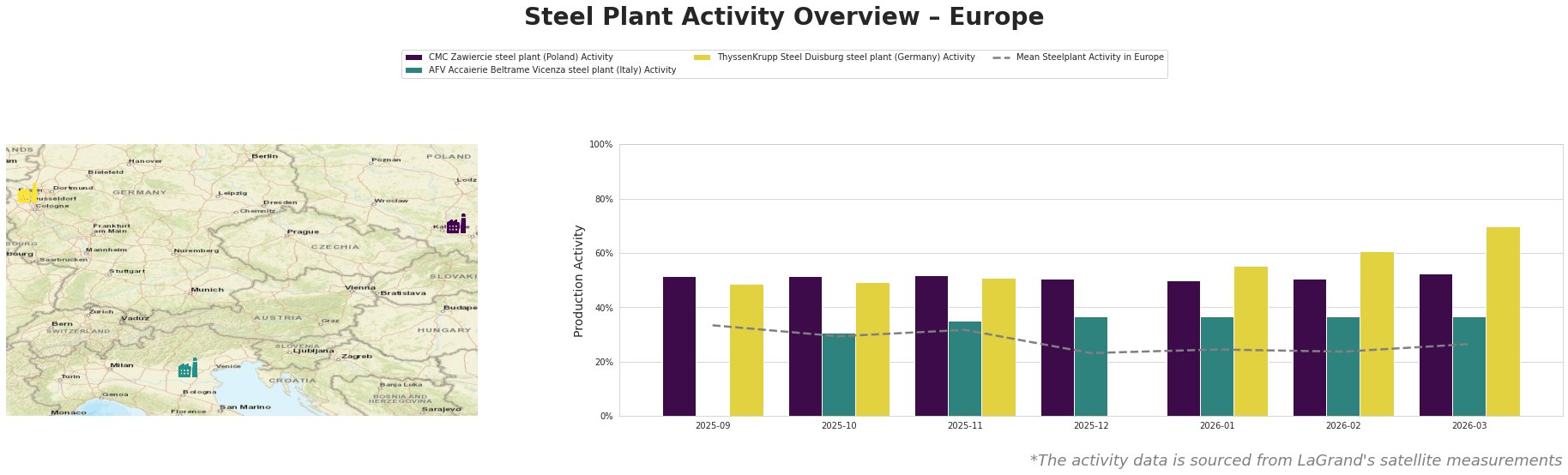
The CMC Zawiercie steel plant in Poland shows an impressive growth trajectory, increasing to 53.0% in March 2026 from 51.0% in September 2025. This aligns with “Poland will insist on special provisions regarding the ETS“, as local concerns over energy pricing might drive production adjustments that cater to the domestic market.
At the AFV Accaierie Beltrame in Italy, activity levels have remained relatively stable, with a maximum recording of 37.0%. There is no direct relationship established to recent news, indicating this plant’s operations are likely less sensitive to ETS arguments at the moment.
ThyssenKrupp Steel in Germany reached a notable activity peak of 70.0% in March 2026, showing robust recovery in production levels after a minimum of 49.0% in September 2025. This increase could be indirectly linked to the ongoing debates on ETS reforms discussed in “EU leaders debate energy, ETS reform,” as the enhancement of the ETS could drive demand for sustainable steel production.
The positive activity trends indicate a favorable environment for procurement, particularly for buyers looking to secure steel from the trending producers. Given the anticipated adjustments in the ETS dynamic, steel buyers should consider securing contracts before any imminent reforms that could influence supply across the region. Specifically, focusing on suppliers like ThyssenKrupp, with rising activity levels, might provide strategic advantages in meeting growing demand as the steel sector adjusts to the regulatory landscape.