


From the Field to the Dashboard – Built by Experts, for Experts.
Discover What's Really Happening in the Steel Industry
Use the AI-powered search engine to analyze production activity, market trends, and news faster than ever before.
Try the Free AI Search EngineSteel Market Update: Asia’s Activity Levels Stabilize Amid Regional Tensions
Recent developments in the steel market across Asia reflect a neutral sentiment, driven by shifts in plant activities post-international negotiations affecting maritime traffic. The news titles, “Hormuz traffic picks up as container ships cross strait“ and “Iran clears 20 Pakistan-flagged vessels through Hormuz,” indicate an increase in shipping activity following Iran’s adjustments to its blockade policies. This uptick may lead to improved access to raw materials and decreased shipping disruptions, yet ongoing political tensions still pose risks to market stability.
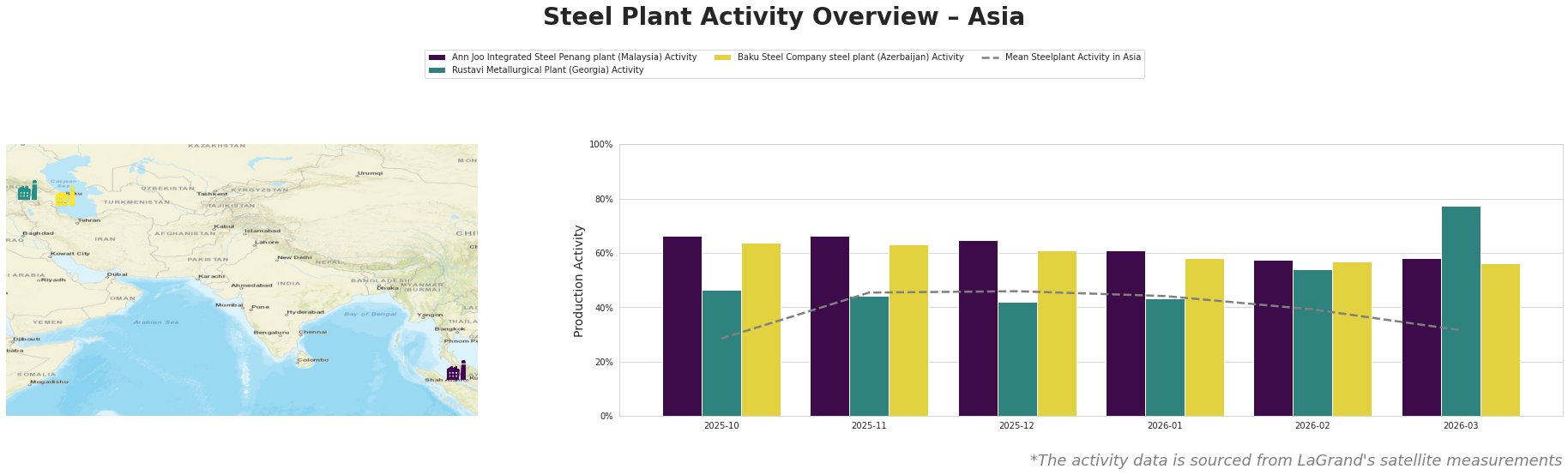
Activity at the Ann Joo Integrated Steel Penang plant has remained consistently high, reducing slightly from 66.0% in February to 58.0% in March. Meanwhile, the Rustavi Metallurgical Plant showed significant volatility, peaking at 78.0% in March following a resurgence in demand, possibly connected to “Hormuz traffic picks up as container ships cross strait,” which may enhance supply stability. The Baku Steel Company demonstrated stability at 56.0%, exhibiting resilience despite broader regional influences. No direct correlation could be established to link fluctuations at the Ann Joo plant with the mentioned news articles, as its activity remained relatively stable.
The Ann Joo Integrated Steel Penang plant operates primarily on an electric arc furnace (EAF) model, producing around 500 tons of crude and semi-finished steel, predominantly serving the construction sector. Its slight activity decline corresponds with regional uncertainty but indicates a steady operating condition amidst external pressures.
Conversely, the Rustavi Metallurgical Plant, boasting a capacity of 120 tons of crude steel, displayed a hardworking operational period with a substantial rise to 78.0% in March. This surge aligns with increased access to shipping routes as highlighted in “Hormuz traffic picks up as container ships cross strait.” Such activity denotes a positive recovery trajectory for manufacturers reliant on imported feedstock.
The Baku Steel Company remains the largest producer in this assessment, with substantial throughput despite market fluctuations, sustaining a 56.0% activity level. This stability may set a benchmark for the market amidst ongoing negotiations as per the trends outlined by the shipping updates.
With the ongoing situation in the Strait of Hormuz impacting trade routes, buyers should prepare for potential supply chain disruptions in the region. Steel procurement strategies should emphasize:
- Engaging with suppliers who have access to reliable shipping lanes, as the relaxation of transit barriers (noted in “Iran clears 20 Pakistan-flagged vessels through Hormuz”) may create more accessible supply chains.
- Monitoring fluctuations at plants like the Rustavi Metallurgical Plant, whose activity levels may shift dramatically with changes in regional political dynamics, ensuring procurement plans remain adaptable.
These insights will be critical for buyers positioning themselves effectively within an emerging yet uncertain steel market landscape in Asia.