


From the Field to the Dashboard – Built by Experts, for Experts.
Discover What's Really Happening in the Steel Industry
Use the AI-powered search engine to analyze production activity, market trends, and news faster than ever before.
Try the Free AI Search EngineSteel Market in Asia Faces Significant Downturn Amid Geopolitical Tensions and Falling Plant Activity
Recent developments in Asia’s steel market are alarming, with geopolitical issues exacerbating an already weak situation. The article Gabriel Felbermayr: Irankrieg für China schmerzhafter als für die USA indicates that the Iranian conflict is leading to increased oil prices, contributing to inflation and stifling economic growth across the region. In parallel, satellite data reveals a noticeable reduction in steel production activity in several significant plants.
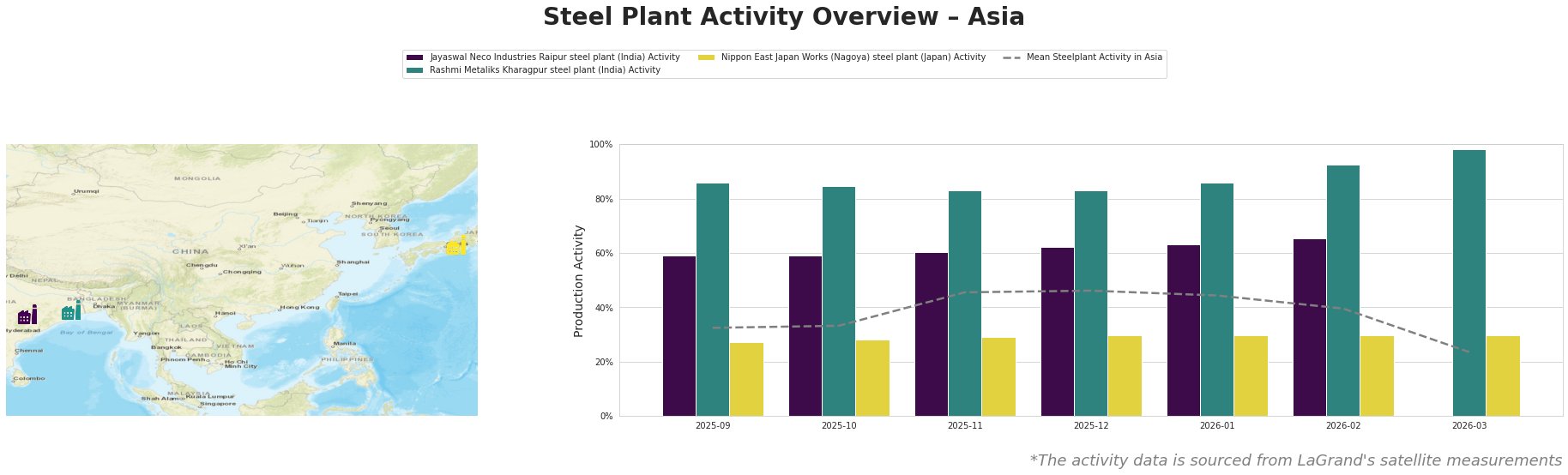
Noteworthy is the sharp decline of mean steel activity to 24% in March 2026, dropping from 40% in February 2026. Jayaswal Neco Industries reported no activity for March, while Rashmi Metaliks surged to 98% capacity, possibly reflecting a strategic pivot amidst market uncertainties. Nippon East Japan remained stable at 30%, indicating little flexibility to adjust amidst external pressures.
At Jayaswal Neco Industries in Chhattisgarh, amid escalating oil prices as highlighted in Teurer Sprit durch Iran-Krieg: Kommt der Tankrabatt zurück?, operational adjustments may be necessary due to their integrated production model’s sensitivity to raw material prices. This could directly impact steel output, further pressuring the regional supply chain.
In contrast, Rashmi Metaliks continues to show strong activity levels, reaching 98% in March, potentially capitalizing on competition’s struggles, as pointed out in Economists warn of lasting economic downturn. This suggests a unique opportunity for procurement teams to engage with Rashmi for immediate needs despite overall market instability.
The Nippon East Japan Works has maintained consistent activity around 30%. However, prolonged geopolitical tensions could disrupt supply chains, as mentioned in Benzin und Diesel: Trotz hoher Spritpreise kein Tankrabatt geplant. Lack of substantial adaptability may put their production at risk in the face of any unforeseen events.
Given the sentiment and observations, steel buyers should prioritize sourcing from Rashmi Metaliks, considering their robust current capacity. Engaging in long-term commitments with producers exhibiting high adaptability, while being cautious of regional instability and its cascading effects, is essential to mitigate potential supply disruptions in Asia’s profoundly perturbed steel market.