


From the Field to the Dashboard – Built by Experts, for Experts.
Discover What's Really Happening in the Steel Industry
Use the AI-powered search engine to analyze production activity, market trends, and news faster than ever before.
Try the Free AI Search EnginePositive Trends in Ukraine’s Steel Sector: Robust Plant Activity Amid Policy Support Calls
Ukraine’s steel industry, particularly in the Dnipropetrovsk and Luhansk regions, is witnessing an upswing in activity levels following urgent calls for policy support from the Welsh government, aimed at bolstering the broader steel sector in Europe. Articles such as “Welsh government calls for immediate UK policy support for steel sector“ and “7 Steel calls for additional sector policy support“ highlight pressures like high energy costs and global overcapacity, paralleled by satellite observations indicating a surge in operational performance at key Ukrainian steel plants.
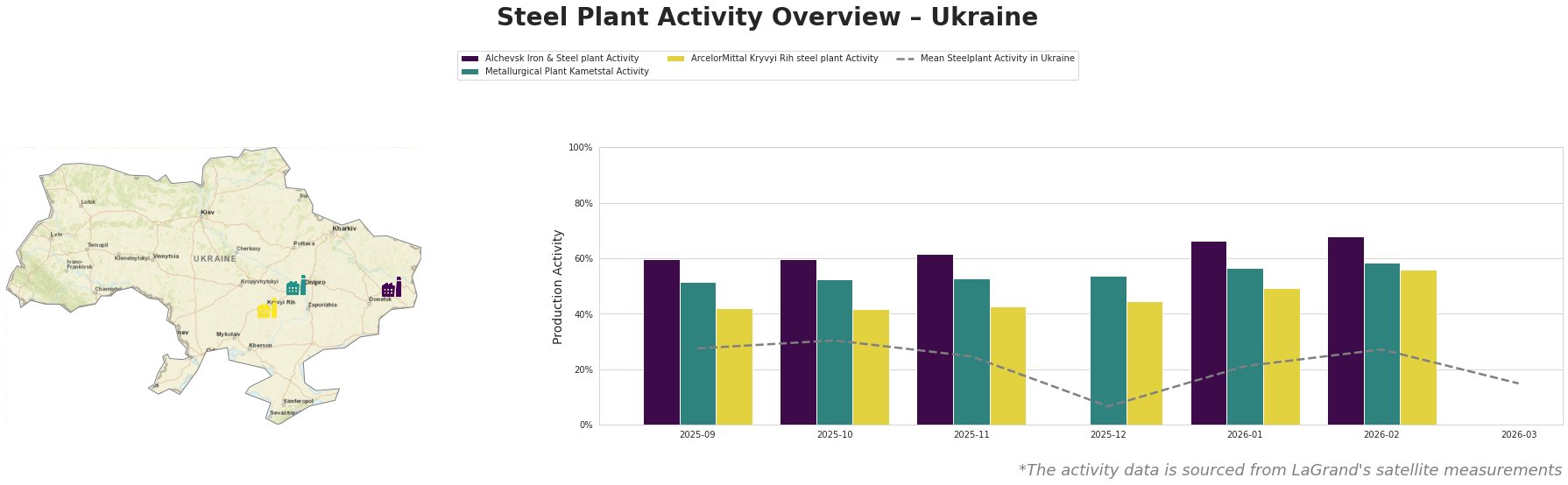
The activity levels at Alchevsk Iron & Steel plant have shown resilience, peaking at 68% in February 2026, a notable response to external pressures indicated by “Welsh government calls for immediate UK policy support for steel sector”, advocating for protective measures amid global challenges. Despite a decline to 15% in March, it remains crucial for buyers to track policy developments closely.
Metallurgical Plant Kametstal remains competitive, with its activity increasing to 58% in February 2026. This stability aligns with the discussed supports for energy pricing, underscored in various articles like “7 Steel calls for additional sector policy support”, indicating a favorable environment for operations and future investments in the plant.
ArcelorMittal Kryvyi Rih shows a gradual climb to 56% activity by February 2026, suggesting effective adjustments to operational strategies in light of the sector’s evolving landscape. The calls for a strong UK Steel Strategy, expected by March, may further solidify the market conditions.
To stakeholders and procurement professionals, these trends suggest a robust supply potential in Ukraine’s steel sector; however, the recent dips in activity prompt immediate actions to secure materials before any unforeseen disruptions arise.
Given the Priorities emphasized in the articles, firms should consider:
- Engaging with Ukrainian suppliers to negotiate favorable contracts, anticipating potential tariff changes and energy price adjustments.
- Increasing procurement from Alchevsk Iron & Steel plant while monitoring policy announcements regarding trade relationships with the UK and EU, which will amplify or alleviate competitive pressures.
- Maintaining close communication with plants such as Kametstal and ArcelorMittal Kryvyi Rih to capitalize on increased activity while being aware of the evolving energy landscape, as urged in the article “7 Steel calls for additional political support for the sector.”
By aligning procurement strategies with observed trends and anticipated policy changes, buyers can ensure a stable supply chain and competitive positioning in the market.