


From the Field to the Dashboard – Built by Experts, for Experts.
Discover What's Really Happening in the Steel Industry
Use the AI-powered search engine to analyze production activity, market trends, and news faster than ever before.
Try the Free AI Search EnginePositive Trends in the Italian Steel Market Driven by Strategic Acquisitions
Recent developments in Italy’s steel market indicate a favorable trajectory, influenced by significant acquisition interests. Notably, “Jindal Steel back in the running to acquire ADI“ highlights Jindal’s renewed commitment to Acciaierie d’Italia (ADI), while the “Flacks Group Eyes Placing Bid on thyssenkrupp Steel Division If Talks With Jindal Steel Fall Through“ illustrates potential shifts in ownership of key assets. Both developments align with an upward trend in observed activity levels at select steel plants.
Measured Activity Overview
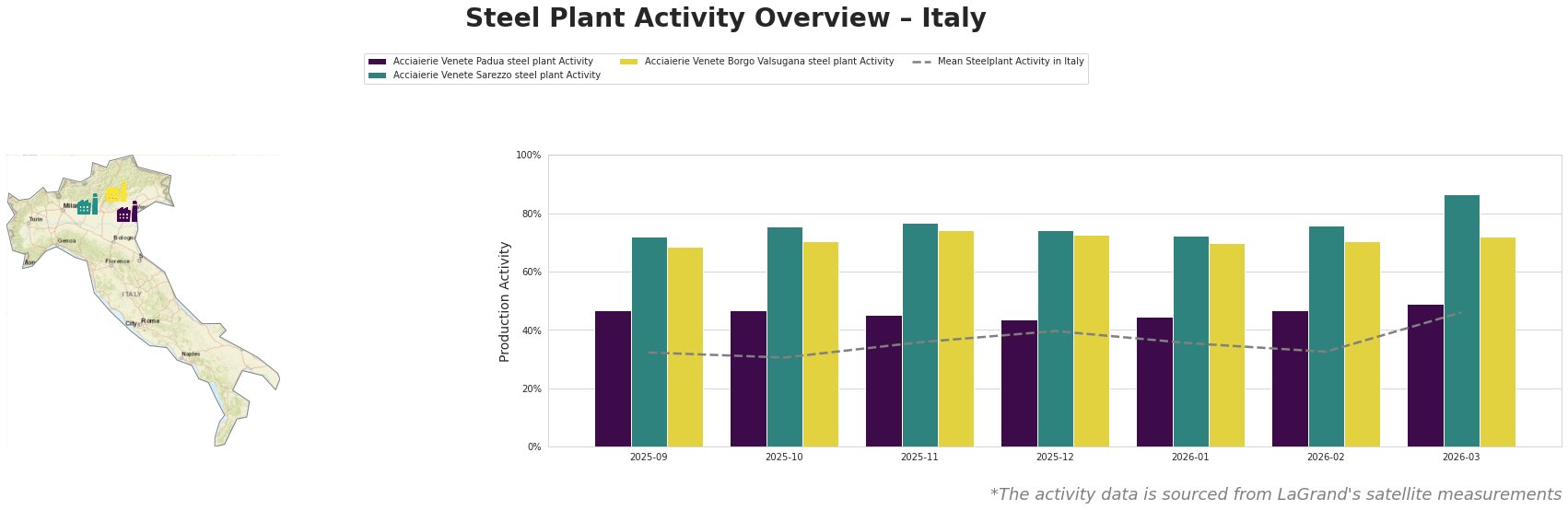
The mean activity level across the monitored steel plants in Italy has shown a notable increase, from 32.0% in September 2025 to 46.0% by March 2026. In contrast, the Acciaierie Venete Sarezzo plant demonstrated remarkable growth, reaching 86.0% activity in March 2026, indicating a rebound in production capabilities. This spike aligns with the positive momentum generated by Jindal’s re-engagement with ADI, suggesting that acquisition-related anticipation is bolstering production forecasts across the sector. Meanwhile, the activity at Acciaierie Venete Padua and Borgo Valsugana has remained relatively stable, fluctuating between 44.0% and 49.0%.
Evaluated Market Implications
The positive sentiment surrounding the potential acquisition of ADI by Jindal Steel directly correlates with enhanced operational activity, particularly noted in the Sarezzo plant, which is poised for increased output. Consequently, procurement professionals should prioritize sourcing from plants like Sarezzo, where output is on the rise, and be prepared to adapt to potential disruptions if acquisition talks between Jindal and ADI or Flacks Group encounter obstacles. Additionally, as maintenance at the Taranto steel plant is expected to be completed by the end of March, steel buyers should monitor developments there closely, as a successful transition could impact overall supply dynamics.
In summary, maintaining close engagement with developments around ADI and adjusting procurement strategies to leverage rising output from Sarezzo and stable operations from other facilities will be crucial for stakeholders in the Italian steel market.