


From the Field to the Dashboard – Built by Experts, for Experts.
Discover What's Really Happening in the Steel Industry
Use the AI-powered search engine to analyze production activity, market trends, and news faster than ever before.
Try the Free AI Search EnginePositive Trends in Asia’s Steel Market Driven by Recent Developments
Recent activity in Asia’s steel sector indicates a positive outlook, bolstered by significant developments in trade and carbon regulation. Notably, the articles titled “EU steelmakers seek to become part of the «Made in Europe» plan“ and “Europe faces industrial hollowing without steel trade reform“ reflect shifting dynamics that could potentially stabilize demand and drive production improvements. Despite the lack of direct connections to satellite data changes from these articles, they set a preparatory tone for increased European market engagement that aligns with growing activity levels.
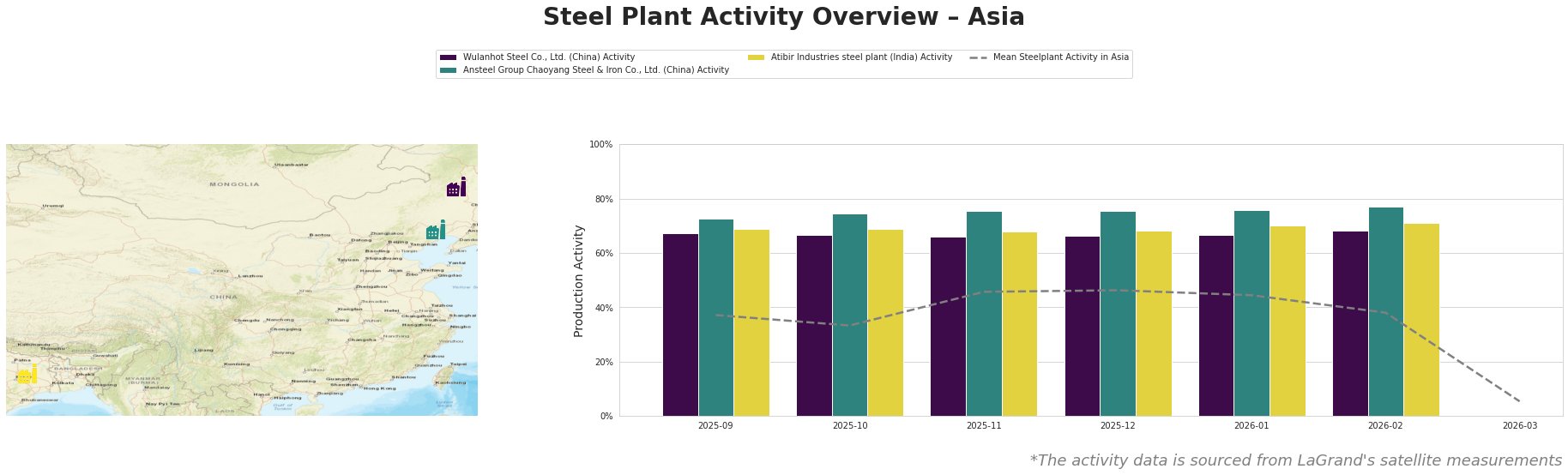
Wulanhot Steel Co., Ltd., located in Inner Mongolia, exhibited stable activity levels, peaking at 68% in February 2026 from lower historical values. This stability may hint at a readiness to ramp up production in response to rising demand indicated by European trade policies, though specific correlations are tenuous. Furthermore, Ansteel Group Chaoyang Steel & Iron Co., Ltd. demonstrated an upward trend reaching 77% in the same period, reflecting its robust operational capabilities of producing up to 2,100 thousand tons of crude steel, which positions it favorably for an anticipated increase in demand. However, specific links to news developments could not be firmly established, suggesting future monitoring is essential.
Atibir Industries steel plant in India, maintaining consistent engagement with levels around 71%, aligns well with overall industry trends but also shows variability; the implications of Indian tariffs and changing market policies domestically could impact these figures as trade relations evolve.
Evaluating trends alongside recent articles highlights potential supply chain adjustments. Given the EU’s initiatives to adapt carbon pricing mechanisms, professionals in steel procurement should proactively assess exposure to price volatility, particularly in light of potential shifts in tariffs affecting imports. Steel buyers should consider securing contracts with Chinese producers who are currently more agile in production adjustments compared to regional counterparts, as evidenced by higher relative activity levels.
To mitigate risks, buyers should prioritize relationships with Wulanhot Steel and Ansteel, taking advantage of their demonstrated capacity to adapt production levels in response to market demands. Continuous monitoring of the EU’s trade discussions and any resulting tariff modifications will be vital for managing procurement strategies effectively.