


From the Field to the Dashboard – Built by Experts, for Experts.
Discover What's Really Happening in the Steel Industry
Use the AI-powered search engine to analyze production activity, market trends, and news faster than ever before.
Try the Free AI Search EnginePositive Shift in North American Steel Market Following Supreme Court Ruling on Tariffs
Recent developments in North America’s steel market indicate a positive trend, bolstered by the U.S. Supreme Court’s ruling on February 19, 2026, where it struck down Trump’s tariffs (US Supreme Court strikes down Trump’s tariffs) under the IEEPA. This decision is expected to reduce trade tensions, improve economic conditions, and may influence future steel production dynamics, as indicated by investors cheering Supreme Court’s decision to strike down Trump’s tariffs. These articles correlate with notable changes in satellite-observed activity levels across several key steel plants in North America.
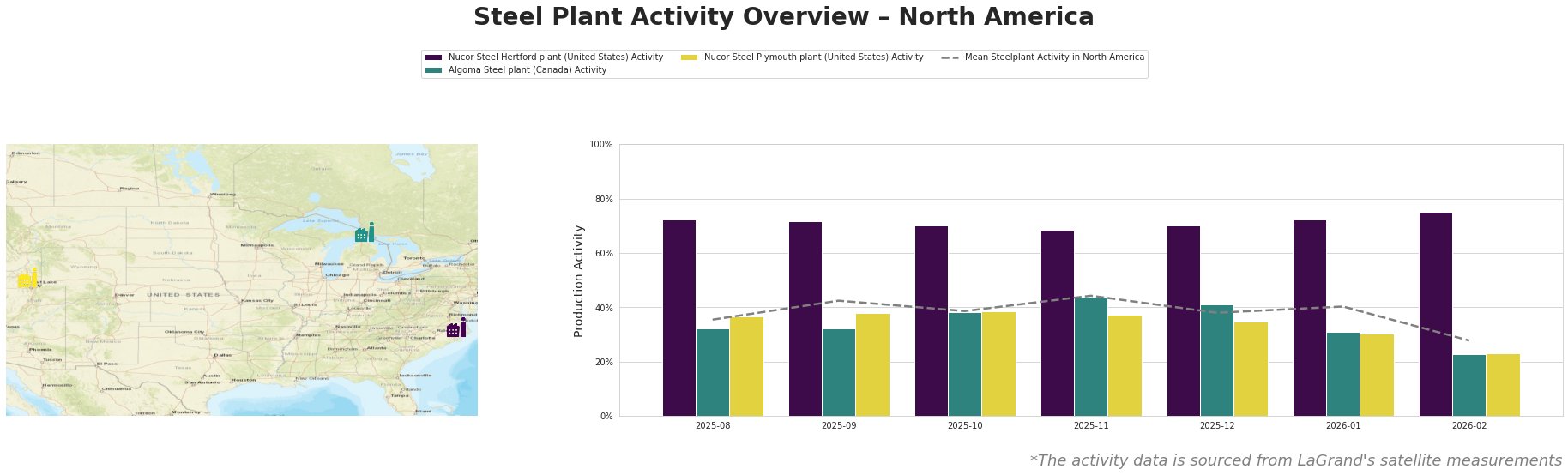
The Nucor Steel Hertford plant registered a significant activity peak at 75% in February 2026, contrasting with the average activity of 28% across all plants, indicating robust operational stability post the Supreme Court ruling. Conversely, the Algoma Steel plant demonstrated notable weakness, with an activity drop to 23%, per the satellite data, with no identifiable correlation to recent news events. The Nucor Steel Plymouth plant faced an overall decline, reaching 23% as well, while not directly linked to external news factors.
The Nucor Steel Hertford plant, located in North Carolina, operates with a capacity of 1,542 tons of crude steel, primarily using Electric Arc Furnace (EAF) technology. It produces semi-finished products like plates for sectors including automotive and infrastructure. The plant’s activity level rise corresponds to the recent ruling, which has boosted market sentiment.
The Algoma Steel plant in Ontario, with a larger integrated capacity of 2,800 tons, is experiencing troubling activity trends, having waned to 23%. This downturn may suggest challenges in meeting projected outputs, but no clear connections to the court ruling or other macroeconomic factors are established.
The Nucor Steel Plymouth plant, with a capacity of 908 tons and focused on finished rolled products like bars, also reflects market activity aligning with the same downturn to 23%. Again, no direct causation to current events is apparent.
Given the landscape shaped by the court rulings, steel buyers and analysts should prepare for potential supply chain adjustments. The Nucor Steel Hertford plant, with its increased activity, suggests a likely potential increase in available steel supplies. Buyers are encouraged to leverage this trend, prioritizing procurement from this facility due to its production efficiency and current operational capacity. Conversely, a cautious approach regarding Algoma Steel and Nucor Steel Plymouth is advisable, as low activity levels may indicate imminent supply challenges.
Maintaining awareness of these developments will be crucial for optimizing procurement strategies in the evolving North American steel landscape.