


From the Field to the Dashboard – Built by Experts, for Experts.
Discover What's Really Happening in the Steel Industry
Use the AI-powered search engine to analyze production activity, market trends, and news faster than ever before.
Try the Free AI Search EnginePositive Outlook for Italy’s Steel Market: Increased Output Planned by Major Producers
Italy’s steel market is witnessing an unprecedented uptick in activity and output as Acciaierie d’Italia (Adi), the country’s largest producer, prepares to ramp up production amid recent financial rescue measures. Notably, the articles “EU rescues Italian steel company amid bankruptcy proceedings“ and “European Commission grants €390 million rescue loan to Acciaierie d’Italia“ reflect the urgency and optimism surrounding Adi’s operations. The approved €390 million rescue loan aims to stabilize Adi’s finances, allowing it to reactivate vital production facilities like blast furnace No. 2 at the Taranto plant. These measures are in direct response to observed satellite data indicating a strategic return to higher operational activity levels.
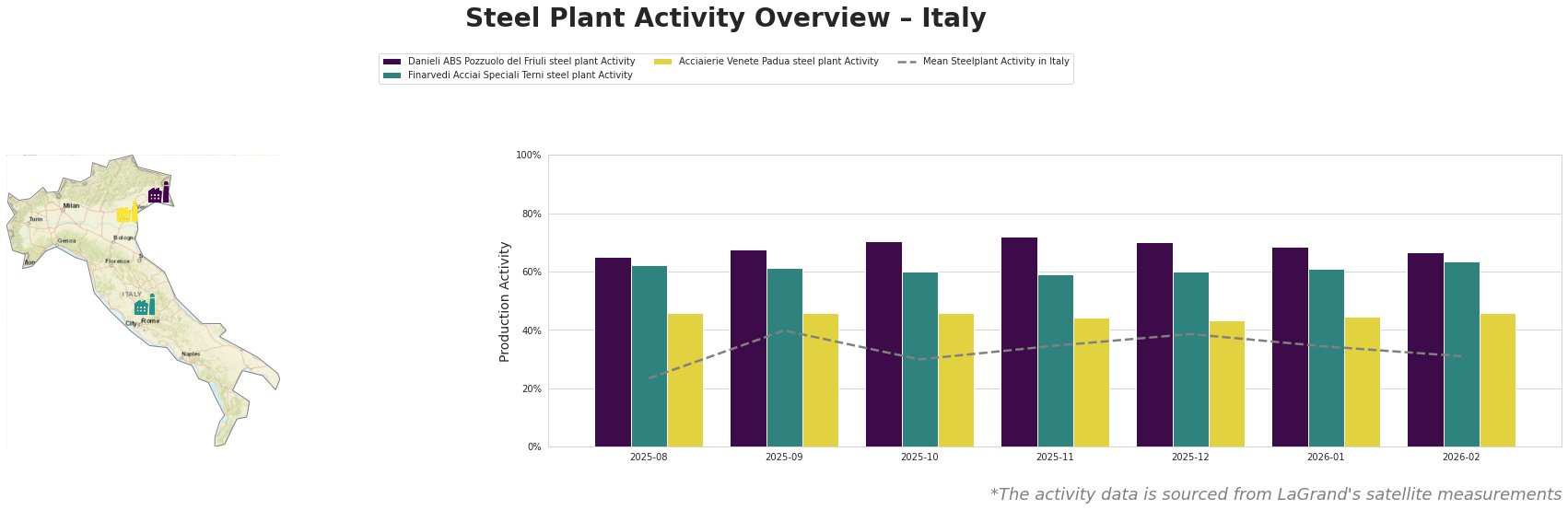
The activity levels across these plants indicate varied trends, especially with Danieli ABS Pozzuolo del Friuli showing a consistently higher activity, peaking at 72% in November 2025. This surge aligns favorably with the increase in regional steel demand and indicates robust operational practices, although specific news connections were not noted. Conversely, Finarvedi’s Terni facility displayed notable resilience, maintaining above-average activity levels, possibly benefitting from broader strategic decisions in Italy’s steel sector as indicated by the restructuring efforts highlighted in “Acciaierie d’Italia plans ramp-up in steel output to 4 million tpy amid government-led restructuring.”
Danieli, Finarvedi, and Acciaierie Venete have demonstrated varying strengths, with Finarvedi maintaining strong levels above the mean activity, partly in response to market conditions and overall demand.
Given the ongoing restructuring efforts and the impact of the rescue loan, potential supply disruptions could arise if Adi recognizes a greater capability than market needs, especially as furnace activations occur. Steel buyers should proactively engage with suppliers to secure contracts reflecting these anticipated increases in production capacity at Adi, particularly targeting prices ahead of an expected uptick in demand. Buyers should also evaluate procurement from Danieli and Finarvedi as these plants bolster their operational capacities, ensuring continuity and potential cost savings in their sourcing strategies.
In summary, the strategic move to reactivate Adi’s blast furnaces and the financial support offered by the EU herald a promising period for Italy’s steel market, purporting significant potential for increased procurement at competitive rates in the near future.