


From the Field to the Dashboard – Built by Experts, for Experts.
Discover What's Really Happening in the Steel Industry
Use the AI-powered search engine to analyze production activity, market trends, and news faster than ever before.
Try the Free AI Search EnginePositive Outlook for European Steel Market: Key Developments and Activity Insights
Recent developments in the European steel market highlight a positive sentiment, driven by government interventions and ongoing discussions around carbon cost management. The article EU approves €78 million Slovenia aid scheme to offset indirect ETS electricity costs indicates governmental measures to assist energy-intensive sectors, including steel, through significant financial support to manage rising electricity costs due to carbon pricing. Furthermore, Dutch parliament urges government talks with steel sector over CBAM cost issues emphasizes ongoing discussions on mitigating emissions charges which impact competitiveness.
Measured Activity Overview
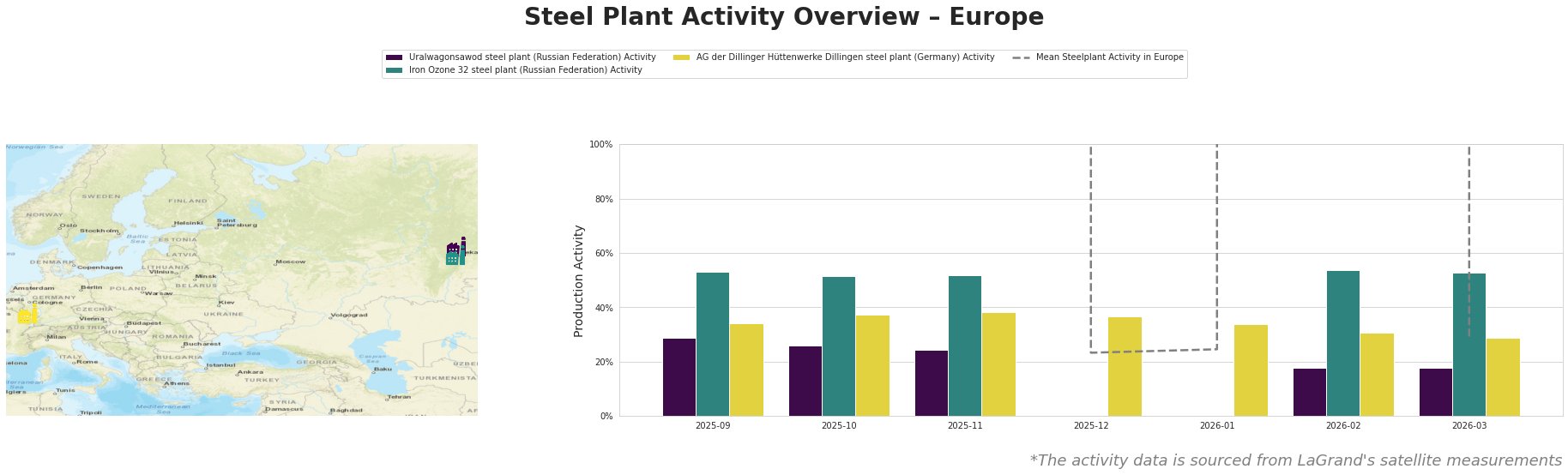
Activity levels in European steel plants have notably fluctuated, with the AG der Dillinger Hüttenwerke experiencing a mild drop from 38.0% in November to 29.0% by March 2026, while maintaining activity levels between 34% and 37%. In contrast, Iron Ozone 32 peaked at 54.0% in February before stabilizing at 53.0%, averaging above the mean activity of 28.0%, indicating robust demand in their product category.
The EU approves €78 million Slovenia aid scheme to offset indirect ETS electricity costs suggests that the financial support in Slovenia may enhance the competitiveness of local steel producers, potentially raising their activity levels as they mitigate electricity cost impacts. However, the Dutch parliament urges government talks with steel sector over CBAM cost issues indicates ongoing cost pressures, and without resolution, could hamper competitiveness even further.
Plant Overview
The Uralwagonsawod steel plant in Rostov, while not publicly specified in activity percentages, has remained low, with figures consistently around 18-29%, indicating operational constraints. There appears to be no direct connection with the current news articles, suggesting an unclear operational landscape influenced by external factors.
The Iron Ozone 32 steel plant, leveraging EAF technology with a capacity of 1250, exhibits strong resilience, maintaining high activity levels above average (54.0% in February). The plant’s performance aligns positively with the sentiment stemming from the European Commission’s support schemes, hinting that proactive energy management could elevate their operational efficiencies.
The AG der Dillinger Hüttenwerke Dillingen holds a competitive edge due to its broader production capabilities, reflected in steady activity despite broader market adjustments. The recent pressure from the Dutch parliament highlights that while local activity may face near-term challenges, established producers like AG der Dillinger may benefit from targeted reforms under discussion.
Evaluated Market Implications
The recent approval of €78 million assistance for Slovenia’s steel sector points towards a potential increase in activity levels within supported firms, fostering competitiveness. Buyers should monitor Slovene producers closely as increasing measures around carbon cost management may bolster their market position. Conversely, the mentioned Dutch parliament motion signals potential compliance burdens that could disrupt pricing structures, suggesting the need for strategic procurement planning.
Steel buyers are advised to initiate discussions with suppliers regarding expected price changes linked to environmental policies and to consider diversifying sourcing, particularly from those markets showing robust growth signals, like Slovenia. Active engagement with local producers will be crucial as the situation develops in line with ongoing governmental support initiatives and sector dialogues addressing compliance woes.