


From the Field to the Dashboard – Built by Experts, for Experts.
Discover What's Really Happening in the Steel Industry
Use the AI-powered search engine to analyze production activity, market trends, and news faster than ever before.
Try the Free AI Search EnginePositive Outlook for Asian Steel Market: Demand Remains Robust Amid Regional Developments
Asia’s steel market shows a positive sentiment driven by significant regional developments, particularly in Southeast Asia. Recent articles including Viewpoint: Southeast Asia to support Asian scrap market and Southeast Asia Steel Expansion to Bolster Regional Scrap Demand Amid Chinese Export Pressures highlight strong demand for scrap in markets like Vietnam and Indonesia, as countries ramp up steel production amidst pressures from increasing Chinese exports. In contrast, Japan’s steel export decline noted in Japan’s Steel Exports Down 3.8% In January–November 2025 reflects regional challenges, though it does not directly relate to the overall increase in Southeast Asian scrap imports.
Measured Activity Overview
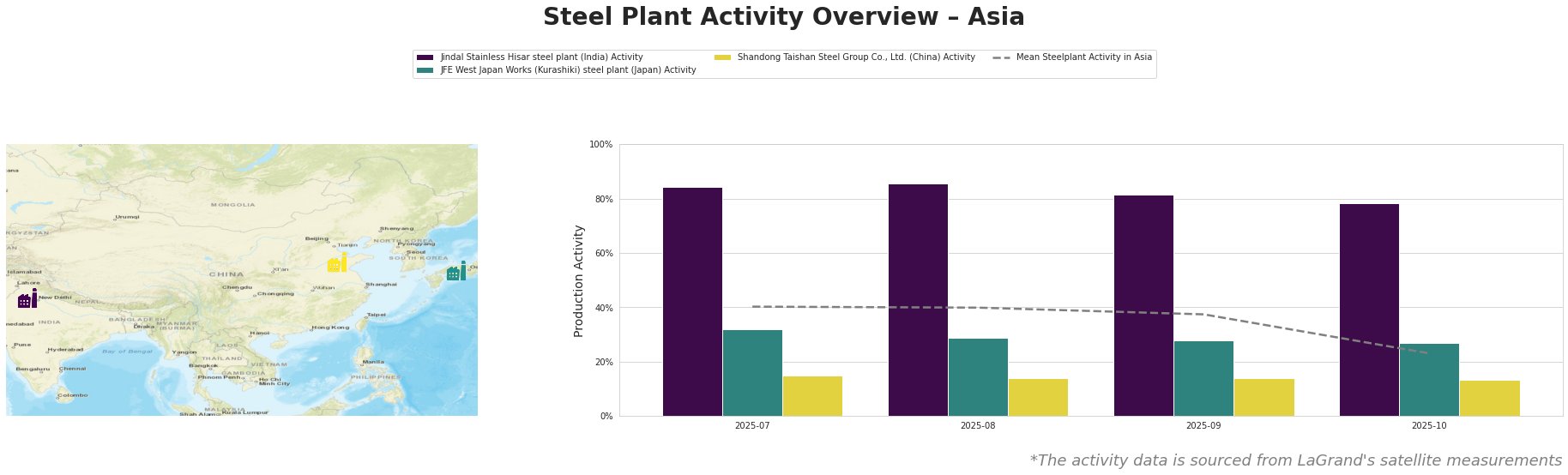
Jindal Stainless Hisar nearly consistently performed above the mean, with activity peaking at 86% in August, emphasizing its strong operational capability despite regional challenges. In contrast, both the JFE West Japan Works and Shandong Taishan Steel Group saw decreases, particularly JFE with a noticeable decline from 32% to 27% by October, aligning with reported weaker steel sales across Asia. However, no direct links could be established from the news concerning Japan’s export decreases to these specific activity shifts.
Evaluated Market Implications
Japan’s ongoing challenges might lead to potential supply disruptions that impact pricing dynamics for Japanese steel products in the near term. For procurement professionals, particularly those focused on the Southeast Asian market, exploiting the robust demand in Vietnam and the expansionary outlook presented in the articles by advocating for increased scrap purchases may yield cost-effective opportunities. Additionally, considering the mentioned pressures from Chinese steel, it is recommended to secure long-term contracts with local suppliers in Southeast Asia, where demand is forecasted to grow owing to infrastructure investments.
Given the complex interplay between regional production capacities, observed activity levels, and external pressures, steel buyers should prioritize aligning their procurement strategies with the performance dynamics within these Asian markets to ensure competitive pricing and supply reliability.