


From the Field to the Dashboard – Built by Experts, for Experts.
Discover What's Really Happening in the Steel Industry
Use the AI-powered search engine to analyze production activity, market trends, and news faster than ever before.
Try the Free AI Search EnginePositive Momentum in Europe’s Steel Market: Ukraine and Germany Show Significant Activity Shifts
In Europe, recent data reveals a surge in steel production and shifting supply dynamics due to regional developments. Notably, Germany increased steel production by 15% y/y in January according to the German Steel Industry Association WV Stahl, while Ukraine increased ferroalloy production by 17% y/y in 2025. These developments correlate with robust activity levels observed across selected steel plants, indicating a positive market sentiment.
Measured Activity Overview
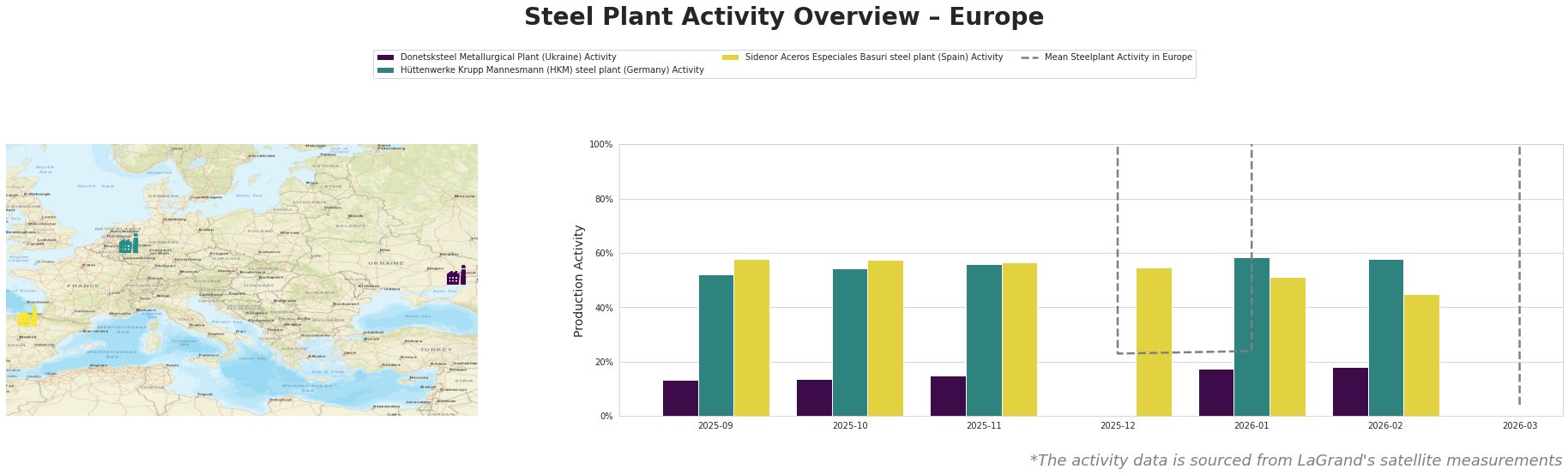
The data indicates that the mean activity across all observed plants in Europe has seen a notable increase from 23% in December 2025 to 43.4% in February 2026. This is complemented by the Hüttenwerke Krupp Mannesmann (HKM) steel plant, which has consistently averaged around 58% activity. Meanwhile, the Donetsksteel Metallurgical Plant has shown a slight upward trend, moving from 15% in November 2025 to 18% in February 2026.
Plant Information
The Donetsksteel Metallurgical Plant, primarily producing pig iron using the integrated BF process, has shown a gradual increase in activity, correlating with Ukraine’s increase in ferroalloy production, as highlighted in the article “Ukraine increased ferroalloy production by 17% y/y in 2025.” However, with no direct link to changes attributed solely to steel activity, the implications remain unclear.
In contrast, Hüttenwerke Krupp Mannesmann (HKM) has experienced growing demand reflected in its highest activity level at 59% in January 2026. This rise aligns with a robust German market vital for supporting steel imports, likely benefiting from Ukraine’s reduced steel export challenges, as mentioned in “Ukraine reduced its exports of long rolled steel by 62% y/y in January.”
Sidenor Aceros Especiales Basuri has seen stable operations around 51-58% activity, although no direct connections to the news articles indicate a substantial relationship between its operations and market changes.
Evaluated Market Implications
The positive production output from Germany amidst Ukraine’s fluctuating export figures suggests potential supply disruptions for steel products, especially long rolled steel. Ukraine’s exports decreased by 61.9% in January**, predominantly impacting EU countries like Poland and Germany. Buyers may face limited availability of certain steel grades from Ukrainian sources.
Steel buyers are advised to adjust procurement strategies proactively, considering the increased production levels in Germany coupled with Ukraine’s domestic market shift. Engaging suppliers from Germany could mitigate risks associated with the reduced Ukrainian supply chain and ensure access to competitive pricing and delivery timelines.