


From the Field to the Dashboard – Built by Experts, for Experts.
Discover What's Really Happening in the Steel Industry
Use the AI-powered search engine to analyze production activity, market trends, and news faster than ever before.
Try the Free AI Search EngineNeutral Steel Market in Iran: Activity Drops Amid Ceasefire Uncertainty
Recent developments in Iran’s steel sector illustrate a market sentiment skewed towards neutrality, driven by the ongoing geopolitical tensions. The articles “Iran steel supply unlikely to benefit from ceasefire“ and “Trump offers 2-week ceasefire to Iran“ outline how major Iranian steel producers have halted operations due to extensive damage from recent airstrikes, specifically impacting Mobarakeh Steel and Khuzestan Steel. Despite the announced ceasefire, recovery in the steel supply chain remains uncertain, with no direct relationship between the ceasefire and imminent activity resumption in steel production.
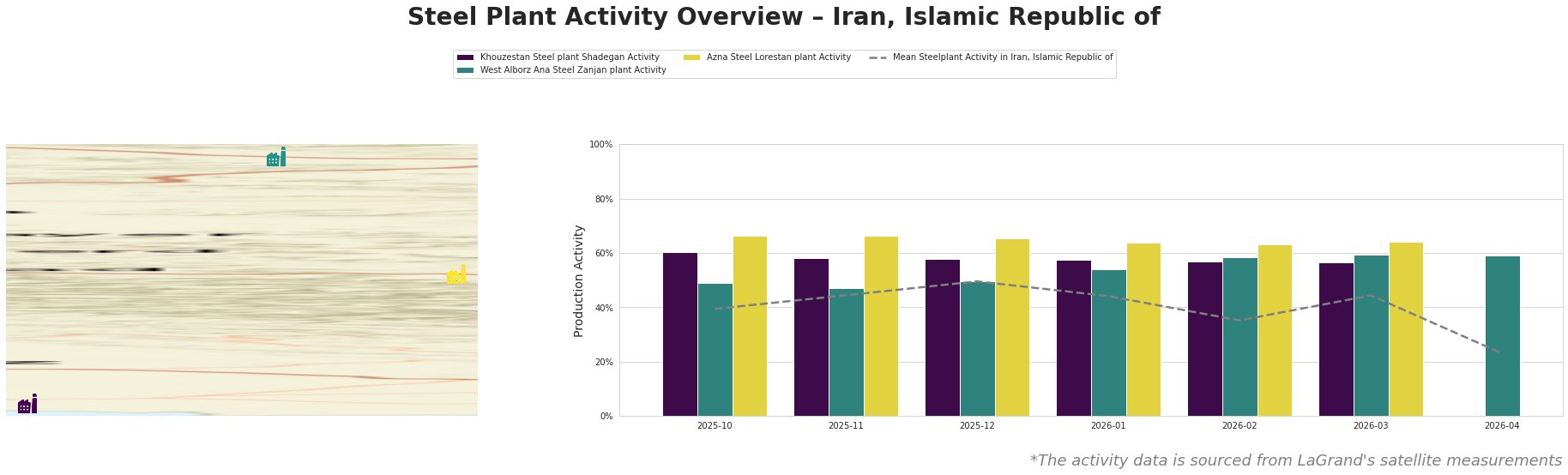
Activity levels show a notable decline; the overall mean dropped sharply from 44.0% in March to 23.0% in April. Khouzestan Steel has been particularly affected, with no recent reported activity due to ongoing repairs. This is consistent with “Iran steel supply unlikely to benefit from ceasefire,” which mentions production halts due to airstrike damages. In contrast, West Alborz Ana Steel’s activity remains stable at 59%, indicating some resilience amidst the broader downturn.
Khouzestan Steel plant Shadegan, with a capacity of 3,600TPA utilizing DRI and EAF processes, has faced significant production constraints, as no observed activity has been recorded in April due to the severe damage outlined in the aforementioned articles. Conversely, West Alborz Ana Steel in Zanjan appears more stable with consistent percentages around 59.0%, indicating less disruption compared to its peers. Azna Steel’s operations were not reported for April, reflecting similar uncertainties.
Given this context, steel buyers should be cautious about procurement due to potential supply disruptions, particularly with Khouzestan Steel where future production levels remain uncertain, as highlighted in the relevant news articles. It is advisable for buyers to explore alternative sources or vendors, notably those not heavily reliant on the Iranian market, to hedge against potential supply shortfalls. Additionally, keeping a close watch on fluctuations in steel prices as they relate to freight and geopolitical stability will be crucial for informed purchasing decisions.