


From the Field to the Dashboard – Built by Experts, for Experts.
Discover What's Really Happening in the Steel Industry
Use the AI-powered search engine to analyze production activity, market trends, and news faster than ever before.
Try the Free AI Search EngineNegative Outlook for Asian Steel Plants Amidst Market Turbulence
Recent developments in the Asian steel market reflect a negative sentiment driven by decreased plant activity. Notably, KISCO steel Changwon plant’s activity stagnated at 43% in January 2026, declining to 38% by February 2026, aligning with the broader adverse trends observed. Additionally, recent changes in energy policies as highlighted in the article, “US to allow resale of Venezuelan oil to Cuba,” suggest potential instability in energy resources critical to steel production, although no direct link to plant activities has been established.
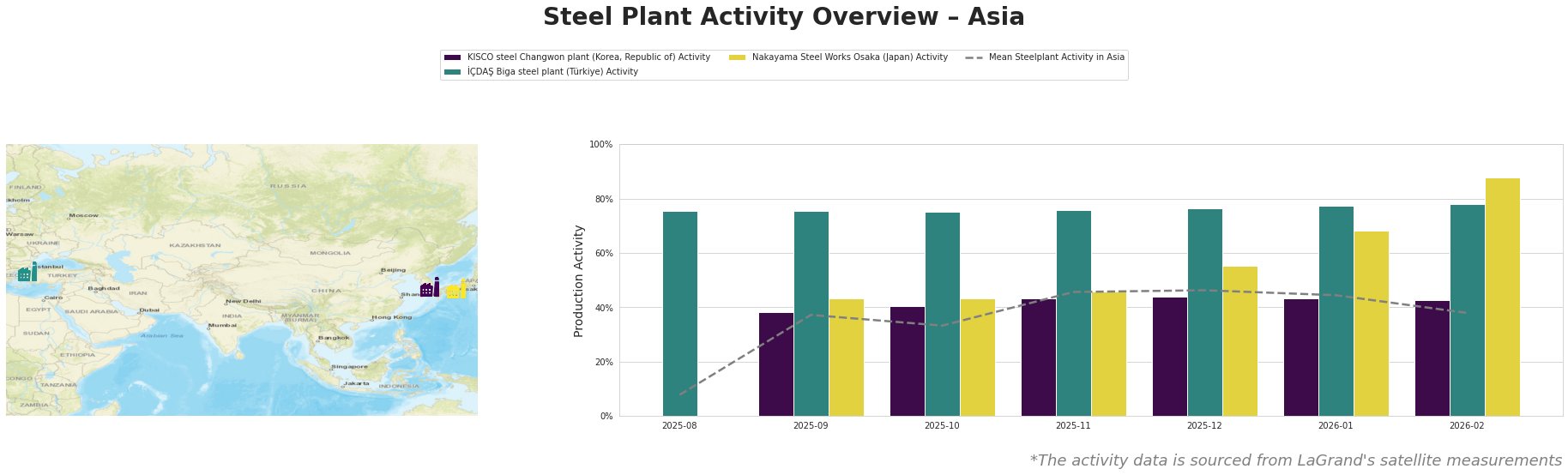
KISCO steel’s output has remained stable, with a mild decline from 43% in January to 38% in February, yet it stands lower than the mean Asian activity level of 44%. This trend mirrors a larger negative market pulse without a specific direct cause from the cited articles.
İÇDAŞ Biga plant displayed resilience with activity peaking at 78% in February 2026 despite concerns over energy security, indicative of the company’s robust operational capability. However, this sharp surge lacks ties to any recent news articles, suggesting it may be driven by internal factors rather than external pressures.
Contrastingly, Nakayama Steel Works Osaka has shown marked growth, escalating from 68% to 88% within the same timeframe. This surge suggests a divergence from the broader negative sentiment while not connecting explicitly to recent geopolitical news, leading to speculation on whether these gains are a temporary aberration.
Evaluated Market Implications
The decrease in activity levels across KISCO (down 5%), resonates with the negative market sentiment driven by geopolitical tensions and energy shortages resulting from evolving U.S.-Cuba relations. Steel procurement professionals should prepare for potential supply disruptions, particularly from KISCO and Nakayama, given their notable fluctuations.
Our recommendation for steel buyers is to negotiate immediate bulk purchases with İÇDAŞ, capitalizing on its currently elevated production activity. This offers a strategic advantage while conditions remain favorable. Monitoring energy prices and geopolitical developments related to the Venezuela-Cuba dynamics will also be critical in anticipating further impacts on supply chains.