


From the Field to the Dashboard – Built by Experts, for Experts.
Discover What's Really Happening in the Steel Industry
Use the AI-powered search engine to analyze production activity, market trends, and news faster than ever before.
Try the Free AI Search EngineNegative Market Sentiment for Europe’s Steel Industry Amid Declining Activity Levels
In Europe, recent satellite data indicates a decline in steel plant activity, contributing to an overall negative market sentiment. Specifically, the AG der Dillinger Hüttenwerke Dillingen steel plant and Donetsksteel Metallurgical Plant have shown notable activity drops, while the ArcelorMittal Méditerranée Fos sur Mer plant maintains a marginal status quo. The declining trends in activity are substantiated by overall mean activity levels observed over recent months.
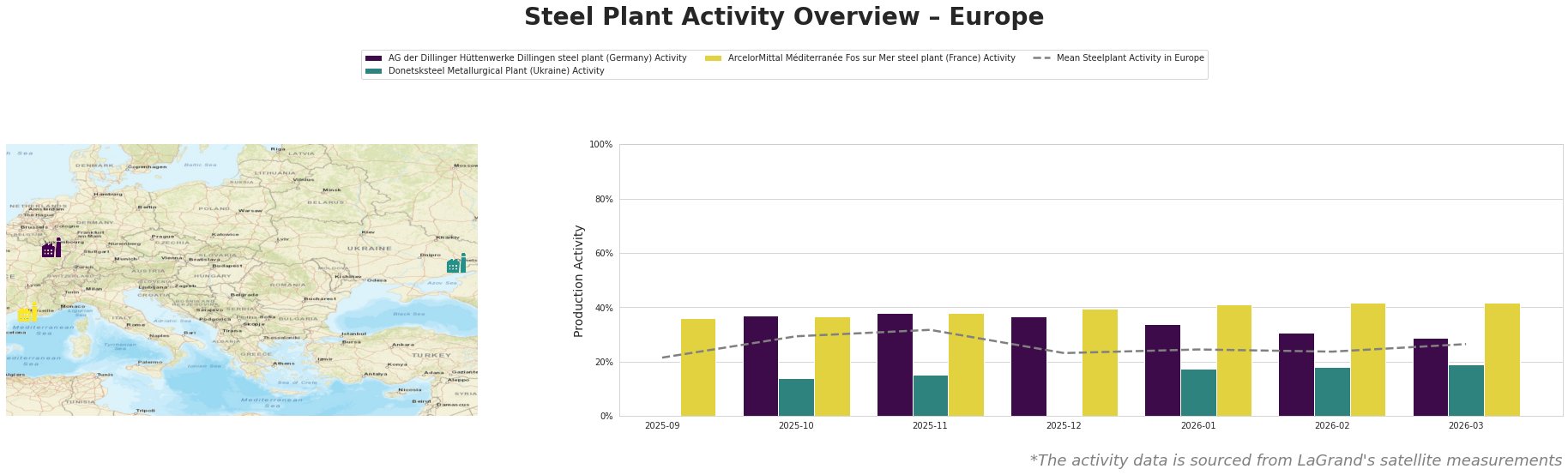
The AG der Dillinger Hüttenwerke saw a decline from 38% in November 2025 to 29% by March 2026, aligning with a weaker market sentiment as reported in the news. The plant, primarily producing semi-finished and finished rolled products, serves vital sectors such as automotive and construction. The inactivity may be driven by economic uncertainty linked to demand fluctuations, although no clear news articles directly confirm this connection.
The Donetsksteel Metallurgical Plant‘s marginal activity of 15% in November 2025 and a slight rise to 19% in March 2026 could indicate attempts at ramping production amidst geopolitical instability, yet the plant remains significantly underperforming compared to other European counterparts.
At the ArcelorMittal Fos sur Mer, the activity levels peaked at 42% by February and March 2026, slightly below its operational capacity. This consistency may be attributed to ongoing stabilization efforts within the facility, though no explicit news links can be established.
Noteworthy is the overall downward trend in activity levels across European steel plants, reflecting a potential supply disruption risk due to fluctuating demand in critical steel-producing regions.
Given the current scenario of declining activity levels and geopolitical uncertainties, steel buyers should consider taking proactive procurement actions. Specific recommendations include:
- AG der Dillinger Hüttenwerke: Given the recent drop in activity, businesses reliant on its products should explore alternative sourcing options to mitigate supply risks.
- Donetsksteel Metallurgical Plant: Buyers should monitor this plant’s operational status closely, particularly as international conditions may affect its productivity.
- ArcelorMittal Méditerranée Fos sur Mer: With stable activity levels, this plant could be a reliable supplier; however, negotiations for better terms could be advantageous amid prevailing uncertainties.
In conclusion, the pronounced negative sentiment in Europe’s steel market necessitates astute sourcing strategies, particularly as activity levels remain volatile.