


From the Field to the Dashboard – Built by Experts, for Experts.
Discover What's Really Happening in the Steel Industry
Use the AI-powered search engine to analyze production activity, market trends, and news faster than ever before.
Try the Free AI Search EngineItaly’s Steel Market Faces Severe Downturn Amidst Rising Costs and Stagnant Demand
Italy’s steel market is currently experiencing a significant downturn, marked by rising prices and decreasing activity levels across key plants. The articles “Italian sections, merchant bar offer prices increase“ and “European longs market ‘tense and static’, price hikes attempted but demand still slow” highlight crucial connections between recent price hikes and weak demand, closely tied to diminished steel plant activity as observed in satellite data.
Measured Activity Overview
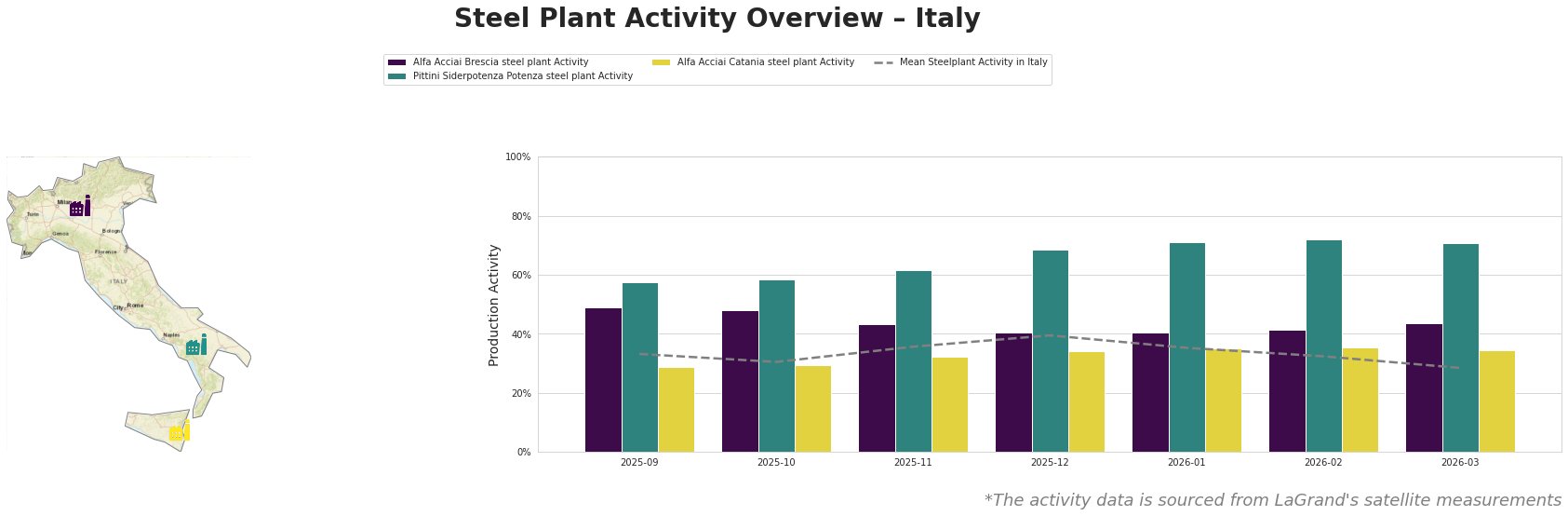
Recent satellite data reveals a drastic decline in overall activity, with a drop to 28.0% mean activity level by March 2026, reflecting stagnation despite previous peaks. This decline aligns with challenges in demand as noted in the articles. Notably, while Pittini Siderpotenza showed relative strength with a peak of 72.0% in February 2026, it too succumbed to a downward trend by March, corroborating insights from “European longs market ‘tense and static’” regarding subdued demand impacting operational viability.
Plant Analysis
Alfa Acciai Brescia Steel Plant: Located in Brescia, this plant operates exclusively using electric arc furnace (EAF) technology with a crude steel capacity of 1,700 tons/year. Activity levels fluctuated, peaking at 49.0% in September 2025 but declining to 44.0% by March 2026. This is indicative of challenges as manufacturers are compelled to adjust production amid heightened energy costs, as referenced in “Italian sections, a shopping bar offer price increases“. The reduction in orders has also influenced this decrease, linking it to weak consumer sentiment.
Pittini Siderpotenza Steel Plant: This plant’s activity peaked at 72.0% in February 2026 before declining back to 71.0% by March. The consistent activity reflects resilience relative to market performance. However, the broader price hikes reported in “European longs market ‘tense and static’” suggest that any slight increases in production will still face headwinds from erratic demand and possible order withdrawals.
Alfa Acciai Catania Steel Plant: Operating under a similar framework as the Brescia plant, this facility’s activity has remained relatively low, peaking at 35.0% before experiencing a slight retreat to 34.0% by March 2026. Its reliance on decreasing orders further complicates its ability to rebound effectively within the current environmental conditions.
Evaluated Market Implications
Supply disruptions are expected, particularly for rebar, as manufacturing costs rise without guaranteed returns on increased prices, as noted in “Italian sections, merchant bar offer prices increase”. Buyers should prepare for the likelihood of higher prices amidst lower stock availability, especially from Alfa Acciai Catania, which has shown a declining trend.
Procurement teams should consider the following actions:
- Diversify Supplies: Given increased uncertainty and temporary price spikes, sourcing from multiple suppliers, including international markets where prices are still competitive, may mitigate exposure to local market volatility.
- Negotiate Terms Early: As producers express challenges in passing on price increases, taking proactive steps to negotiate longer-term contracts may provide stability in pricing against the backdrop of rising raw material costs.
- Monitor Plant Activity: Continued observation of plant activity through satellite data will be vital in anticipating supply security and adjusting procurement strategies accordingly.
In light of the current market sentiment described as Very Negative, these measures will help steel buyers navigate the turbulent landscape ahead.