


From the Field to the Dashboard – Built by Experts, for Experts.
Discover What's Really Happening in the Steel Industry
Use the AI-powered search engine to analyze production activity, market trends, and news faster than ever before.
Try the Free AI Search EngineEurope Steel Market Update: Neutral Sentiment Amid Compliance Cost Concerns
Recent activity in Europe’s steel market reflects a neutral sentiment driven by regulatory developments and associated plant activities. The articles “Dutch parliament urges government talks with steel sector over CBAM cost issues” and “Italy and France push EU for faster ETS, CBAM reforms to protect industry” highlight rising anxiety over compliance costs tied to the EU’s Carbon Border Adjustment Mechanism (CBAM). These developments correlate with declining activity levels at key steel plants, notably the Uralwagonsawod and AG der Dillinger Hüttenwerke Dillingen.
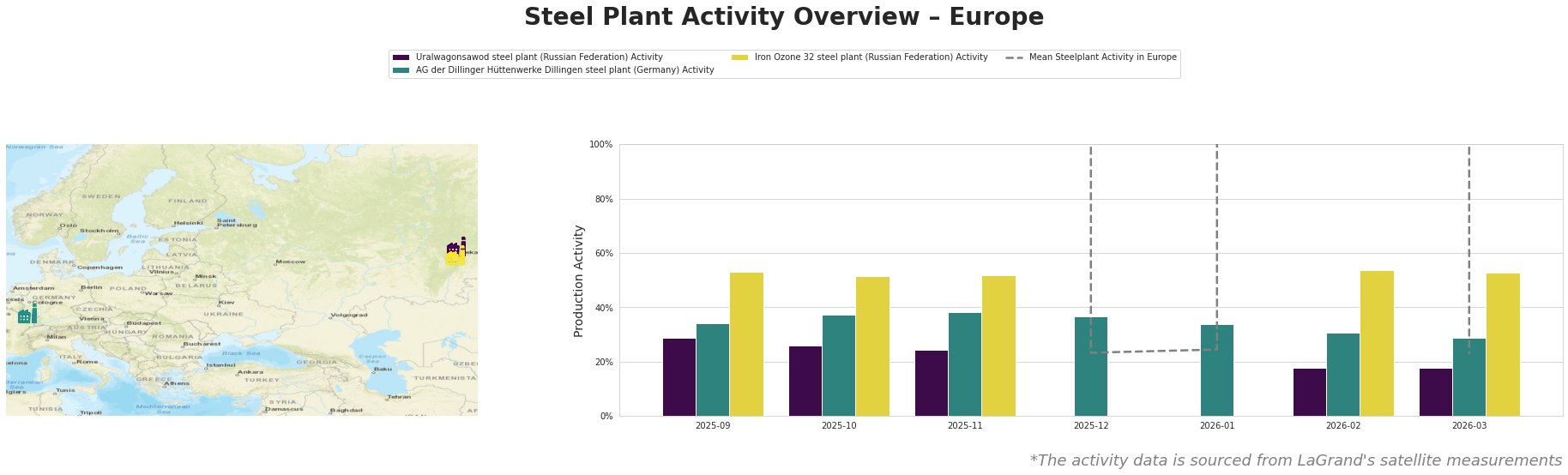
Uralwagonsawod’s activity has significantly declined to 18% as of March 2026, reflecting the 18% also seen in February. This decreasing trend appears disjointed from regulatory pressures as there is no direct linkage to the discussed CBAM issues. Conversely, AG der Dillinger Hüttenwerke’s activity dropped from 38% in November to 29% in March, echoing concerns raised in both “Dutch parliament urges government talks with steel sector over CBAM cost issues” regarding manufacturers’ compliance costs. Iron Ozone 32 remains stable with similar activity but shows no direct correlation to recent developments.
The AG der Dillinger Hüttenwerke plant, a major integrated steel producer, is experiencing compliance-related pressures affecting its operations. Its drop in activity mirrors regulatory concerns highlighted in the recent news articles, reinforcing the notion that compliance burden is hindering outputs.
For steel procurement professionals, proactive engagement with suppliers facing stripping regulations is advisable, particularly in the wake of pressing calls for CBAM reforms. Buyers should negotiate pricing and explore contracts with flexibility built around compliance cost adjustments. Given the urgency stated by industry officials, aligning procurement timelines to conclude before mid-2026 will likely yield better terms, minimizing exposure to potential further hikes in compliance-related charges.