


From the Field to the Dashboard – Built by Experts, for Experts.
Discover What's Really Happening in the Steel Industry
Use the AI-powered search engine to analyze production activity, market trends, and news faster than ever before.
Try the Free AI Search EngineEurope Steel Market Analysis: Rising Prices Amidst Activity Fluctuations and Supply Disruptions
Recent developments in the European steel market reflect a neutral sentiment amid fluctuating plant activity and rising prices. Notably, “The forecast for steel prices in the UK is strengthening due to the reform of protective measures and the change in the CBAM market“ highlights significant supply constraints and increased duties impacting the UK and EU markets. Concurrently, “Distributors slow to capitalise on EU coil hikes” indicates rising prices of hot rolled coils amidst low demand, while “UK HRC discount to north EU expands“ details significant price drops in the UK, suggesting potential market arbitrage.
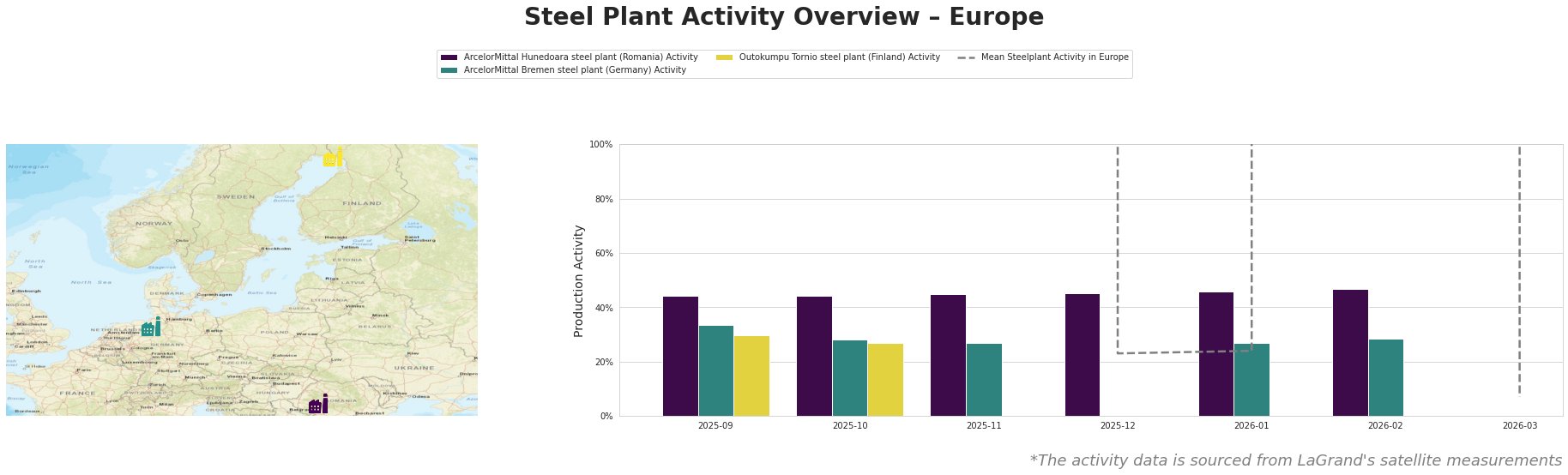
The activity levels at ArcelorMittal Hunedoara demonstrated stability, peaking at 47% in February 2026, indicating robust production of finished rolled products, likely linked to regional demand dynamics and recent protective measures changes noted in the aforementioned news articles. Conversely, ArcelorMittal Bremen’s activity decreased significantly, dropping to 28% in January 2026, likely connected to the “Distributors slow to capitalise on EU coil hikes,” as lower coil demand may affect production output.
Meanwhile, Outokumpu Tornio displayed consistent low activity, averaging 27-30%, along with a lack of relevant connections to the outlined news articles. This suggests possible underutilization in response to fluctuating demand conditions rather than direct supply constraints.
Evaluated Market Implications
Supply disruptions can be anticipated at key facilities, particularly in the UK where protective measures are expected to affect pricing from July 2026, as outlined in “The forecast for steel prices in the UK is strengthening…” This necessitates strategic procurement planning for buyers to manage potential price increases effectively, especially for long products affected by the tight quota environment.
Steel buyers, particularly in the EU, should actively seek competitive pricing opportunities resulting from the UK HRC discount to north EU expands, positioning themselves to potentially capitalize on lower UK prices. Conversely, with rising prices in the EU and unstable demand conditions, procurement strategies should focus on timing and flexibility in sourcing raw materials and finished products, especially given the volatility reflected in recent production levels across European plants.
In conclusion, vigilant market monitoring coupled with adaptive procurement strategies is essential for navigating the complexities arising from these dynamic market conditions.