


From the Field to the Dashboard – Built by Experts, for Experts.
Discover What's Really Happening in the Steel Industry
Use the AI-powered search engine to analyze production activity, market trends, and news faster than ever before.
Try the Free AI Search EngineEurope Steel Industry: Stability Amid Fluctuating Activity Levels
European steel market activity remains neutral as regional plants encounter varied operational changes. Notably, “Australia’s NSW government considers fuel intervention” drew attention towards localized supply challenges but does not directly correlate with European operations. Recent satellite-observed activity trends, however, reveal fluctuations across three key European steel plants amid varying degrees of external pressures.
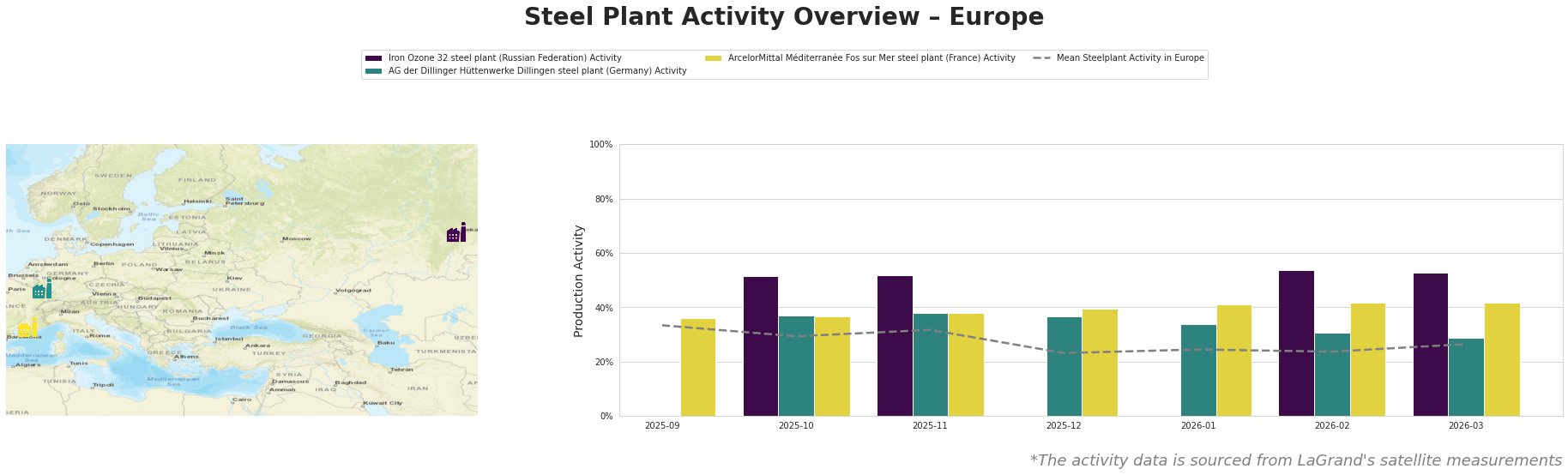
For the Iron Ozone 32 steel plant, situated in Sverdlovsk and using Electric Arc Furnace (EAF) technology, observed activity showed significant peaks at 54% in February 2026 followed by a minor downturn to 53% in March 2026. Such fluctuations lack direct connections to any recent news articles, indicating independent operational factors at play.
The AG der Dillinger Hüttenwerke in Saarland maintains a steady level of efficiency and experienced an activity drop to 29% in March 2026, down from 38% in November 2025. Additionally, there has been no evident alignment with external news developments, suggesting potential internal operational challenges without direct external causal relationships.
Meanwhile, the ArcelorMittal Méditerranée Fos sur Mer steel plant has sustained a consistent operational baseline, keeping activity at 42% in both February and March 2026, following a modest increase from 39% in December 2025. Again, this stability does not link with external events, signaling resilience within its operational strategies.
Potential Supply Disruptions and Procurement Actions:
– With AG der Dillinger Hüttenwerke’s drop to 29%, buyers should monitor procurement schedules closely in case of further declines, potentially aligning with inventory replenishments and assuring against backlogs.
– The fluctuations at Iron Ozone may prompt targeted strategic sourcing for semi-finished products; procurement professionals should engage in risk management to mitigate uncertainties linked to production disruptions.
– Maintaining relationships with suppliers at ArcelorMittal Fos sur Mer appears prudent, given its stability during volatile months, ensuring continued access to critical product lines.
In summary, while the European steel industry exhibits mixed activity levels, strategic procurement actions tailored to these insights can help mitigate potential risks while capitalizing on operational stability.