


From the Field to the Dashboard – Built by Experts, for Experts.
Discover What's Really Happening in the Steel Industry
Use the AI-powered search engine to analyze production activity, market trends, and news faster than ever before.
Try the Free AI Search EngineAsia’s Steel Market Faces Severe Pressure Amid Surging Exports and Excess Capacity Crisis
Asia’s steel market sentiment has turned distinctly negative, as highlighted by the OECD Steel Committee warns global steel excess capacity crisis deepens as China exports surge. The report reveals a staggering surge in China’s steel exports to 131 million metric tons and a continuing decline in global demand over the past four years. These challenges correlate directly with recent satellite data indicating significant activity reductions in multiple plants across the region.
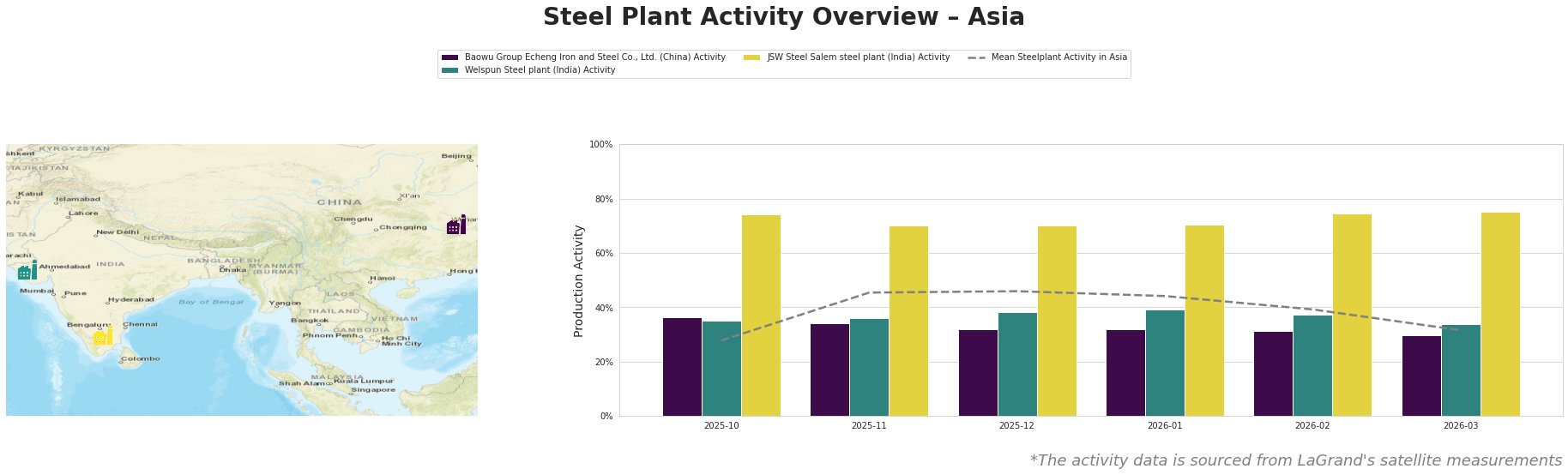
Recent data shows marked declines in activity, particularly at Baowu Group, which dropped from 36.0% in October 2025 to 30.0% by March 2026, exceeding the mean decline for all plants in Asia. This trend aligns with the OECD’s assertion of excessive production capacity in non-OECD economies like China, contributing to diminished activity levels and the oversupply crisis.
Baowu Group Echeng Iron and Steel Co., Ltd. reported a notable downward shift in activity, falling to 30.0% in March 2026. This reduction links directly to the declining market conditions outlined in the OECD warns of a deepening crisis in the global steel industry. The rise in Chinese steel exports has likely pressured domestic demand, further reinforcing lower activity levels.
In contrast, Welspun Steel and JSW Steel Salem exhibited relatively stable activity levels, maintaining around 75.0% with slight fluctuation by March. However, their performance could be impacted by competitive pressures induced by China’s export dynamics, as described in the OECD: Global steel capacity reaches record high.
Buyers should be cautious about potential supply disruptions, particularly from Baowu Group, where activity dips signal possible operational constraints. Immediate procurement strategies should consider diversifying supply sources, particularly from JSW Steel Salem, which currently demonstrates stable operational levels despite the overall market’s downturn. Engaging contracts with plants showing resilience amid this crisis—like JSW—could mitigate risks associated with the heightened competition and oversupply situation highlighted in the adopted articles.