


From the Field to the Dashboard – Built by Experts, for Experts.
Discover What's Really Happening in the Steel Industry
Use the AI-powered search engine to analyze production activity, market trends, and news faster than ever before.
Try the Free AI Search EngineAsia Steel Market Report – Strong Activity Amid Duty Increases
In Asia, recent developments indicate a very positive market sentiment, particularly reflected in Qatar’s strategic moves to increase customs duties on rebar and wire rod. The announcements titled “Qatar raises import duties on rebar and wire for 2026“ and “Qatar: Increase in Customs Duties on Rebar and Wire Rod“ align with notable increases in plant activities, especially observing a stable trend in the Solb Steel Jizan plant (Saudi Arabia), which displayed an activity level of 81% as of January 2026, hinting at robust production capability amid shifting market conditions.
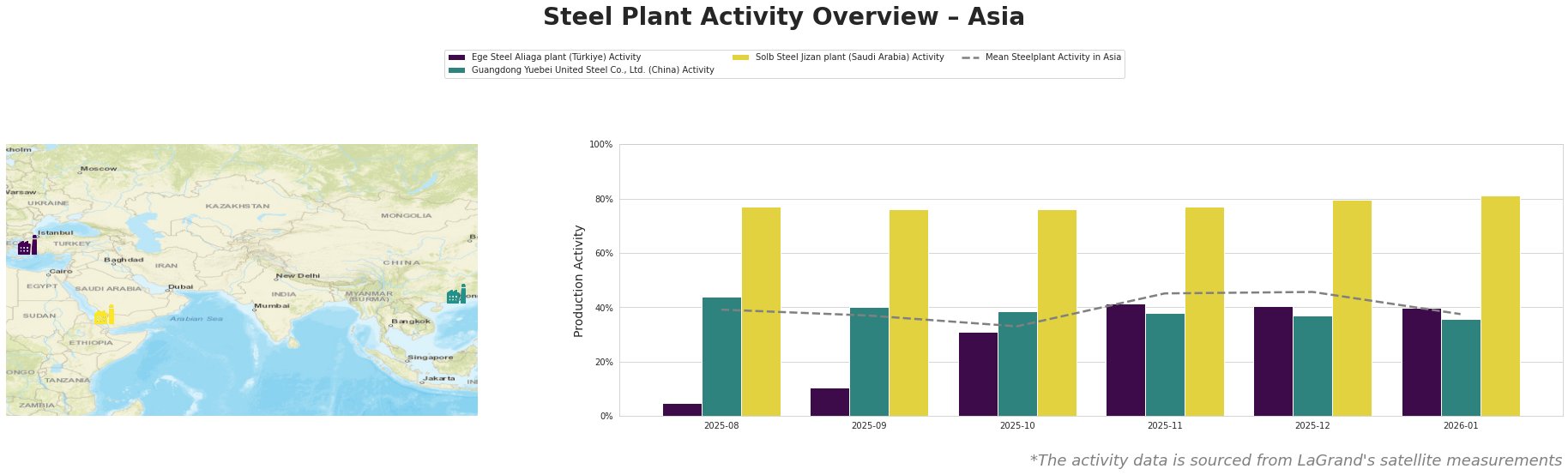
The Ege Steel Aliaga plant in İzmir, with a capacity focused on rebar and wire rod from Electric Arc Furnace (EAF) technology, recorded stabilization at 40% in January 2026. However, it reflects a significant activity fluctuation due to external market pressures but shows resilience amid rising duties tailored to protect local markets from foreign competition, particularly from Chinese imports, as indicated by recent news.
Guangdong Yuebei United Steel Co., Ltd. experienced a drop to 36% activity, likely influenced by the increased competition and pricing pressures spurred by the recent duty escalations in Qatar. The firm primarily produces rebar and serves the infrastructure sector. The constraints in the region may hinder the company’s operational capacity as it adjusts to the rising customs landscape.
In contrast, Solb Steel Jizan plant exhibited robust activity at 81%, underscoring its competitive advantage amidst the shifting dynamics fueled by duties imposed in neighboring markets. Positioned strategically with EAF technology, the plant’s consistent output showcases its ability to meet production demands in the face of potential disruptions elsewhere.
Given these insights and observed trends, it is recommended that steel buyers consider increasing their procurement from the Solb Steel Jizan plant as it shows the best stability and capacity to fulfill orders, particularly as a reaction to Qatar’s customs duty changes which may impact pricing strategies across the region. Moreover, monitoring the Guangdong steel plant’s shifts may provide further insights into its responsiveness to changing market conditions and pricing strategies stemming from regional tariffs.
In summary, the strategic adjustments in Qatar’s import duties are anticipated to reshape competitive dynamics, thus requiring steel buyers to adapt promptly by securing contracts with reliable suppliers exhibiting stable production levels.