


From the Field to the Dashboard – Built by Experts, for Experts.
Discover What's Really Happening in the Steel Industry
Use the AI-powered search engine to analyze production activity, market trends, and news faster than ever before.
Try the Free AI Search EngineAsia Steel Market Report: Neutral Sentiment Amidst Fluctuating Activity Levels
Recent activity in Asia’s steel market reflects a neutral sentiment, driven largely by fluctuations in production patterns. Notably, satellite observations indicate a steady yet varying output across major plants. Highlighted developments include the US line pipe imports up 45.2 percent in November 2025 from October, signaling increased demand for structural products, although this contrasts with other reported declines, such as US OCTG exports down 10.9 percent in November 2025 from October.
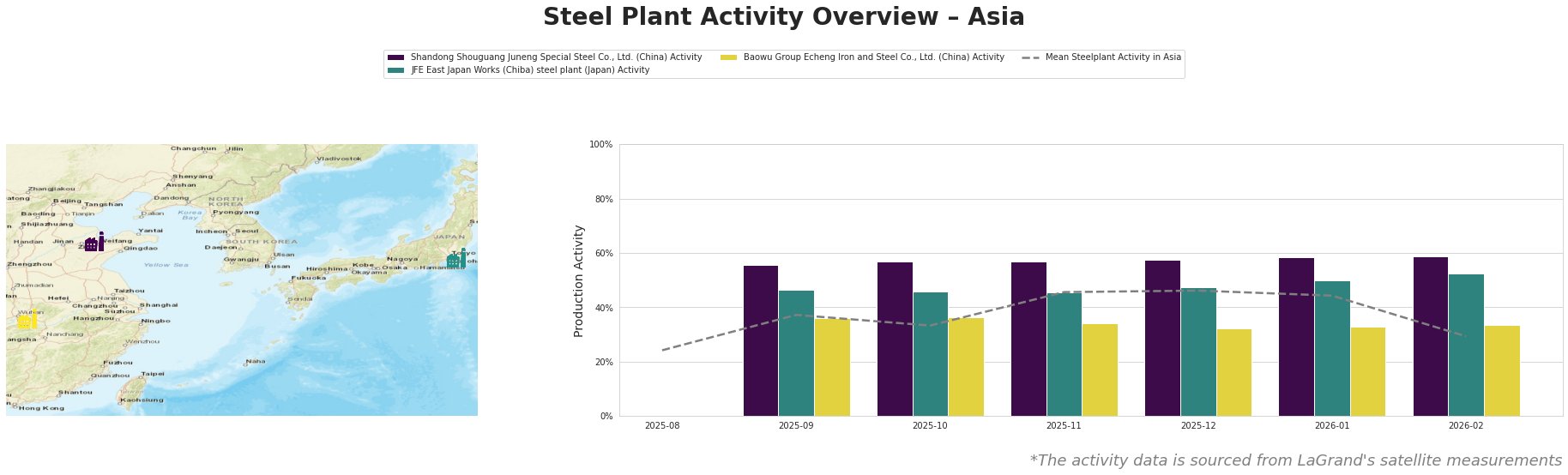
The Shandong Shouguang Juneng Special Steel Co., Ltd. observed a peak activity of 59.0% in February 2026, up from 56.0% in September. This steady production aligns with the rising demand for finished steel products reported in the mentioned articles but lacks a direct correlation to the observed imports or exports in the US.
Conversely, the JFE East Japan Works (Chiba) plant saw fluctuating activity with a high of 52.0% in early 2026, indicating stable operational performance without clear ties to the US import dynamics. The ongoing shifts suggest a regional focus on maintaining output amid fluctuating global demand.
Baowu Group Echeng Iron and Steel Co., Ltd. shows a decline from 36.0% in October to 34.0% in November and 32.0% in December, indicating potential vulnerabilities in meeting timely demands amid oscillating international market conditions. This drop could relate to broader challenges tied to exports but lacks direct evidence from the provided news.
Given this landscape, potential supply disruptions from the Baowu plant necessitate proactive procurement measures from steel buyers. Companies should consider diversifying their supplier portfolios, particularly due to the increased US line pipe demands, which may create upward pressure on domestic pricing and availability in Asia.
Procurement teams should closely monitor activity levels across these key plants, especially amid changing market signals and varying productivity rates. Immediate strategic sourcing efforts are recommended, focusing on balancing long-term contracts with short-term needs based on the dynamic activity landscape in Asia’s steel sector.