


From the Field to the Dashboard – Built by Experts, for Experts.
Discover What's Really Happening in the Steel Industry
Use the AI-powered search engine to analyze production activity, market trends, and news faster than ever before.
Try the Free AI Search EngineAsia Steel Market Report: Activity Plummets Amid Geopolitical Tensions
Recent turmoil in the Middle East is adversely impacting the steel market in Asia, with substantial declines in steel plant activity observed. Significant crisis events, most notably in the articles “Sulphur exports caught up in conflict shorten market” and “Chinese domestic sulphur prices surge on Iran crisis,” detail disruptions in key production facilities and heightened sulphur prices. These developments correlate with observable reductions in activity levels at prominent Asian steel plants.
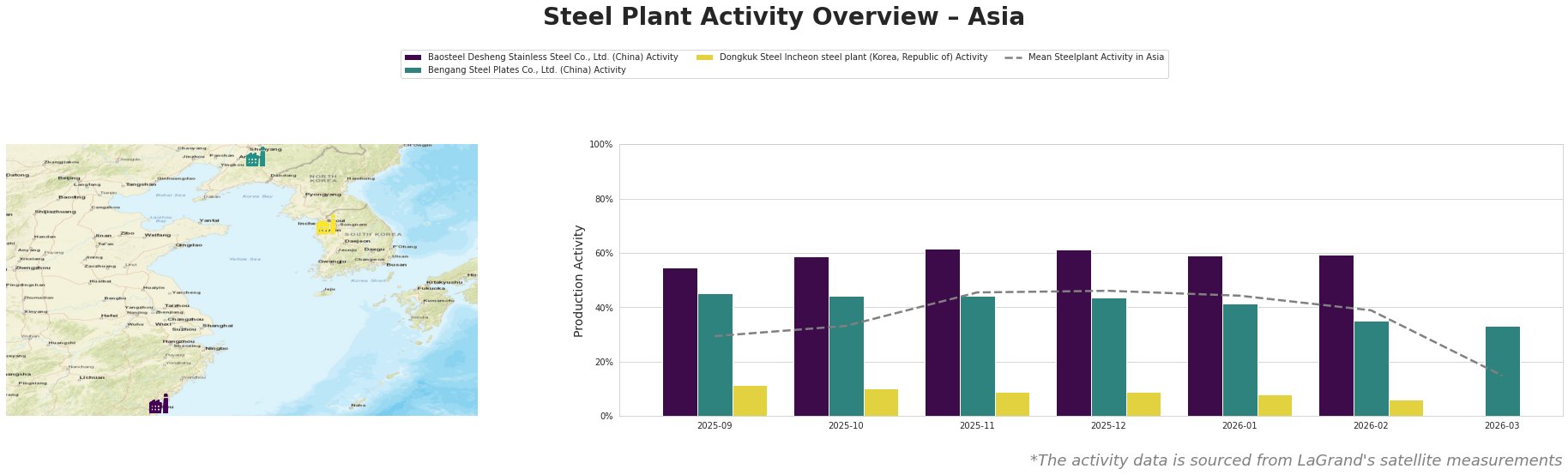
For Baosteel Desheng Stainless Steel Co., located in Fujian, the latest data reflects a notable activity decline to 15% in March 2026, down from 59% in February. This 74% drop may be linked to increased operational risks highlighted in “Sulphur exports caught up in conflict shorten market”, which demonstrates how the geopolitical tensions have escalated logistics disruptions, complicating steel procurement.
Bengang Steel Plates Co., in Liaoning, exhibited a decrease to 33% activity in March 2026, aligning with the broader market decline. The continuous concern around potential sulphur supply shortages, as discussed in “Chinese domestic sulphur prices surge on Iran crisis,” also hints at underlying operational and pricing pressures faced by the company, impacting its capacity to maintain output.
Dongkuk Steel Incheon in Korea displays a severe drop in activity, with the latest data (March 2026) reflecting no recorded activity. This zero activity can be indirectly related to disruptions caused by regional instability and the implications mentioned in the previously noted news articles.
Overall, the current reduction in activity across these plants signifies potential supply disruptions. Specifically:
- Baosteel Desheng: Buyers should be aware of possible raw material shortages and longer procurement cycles, as suggested by conflict-induced logistical problems.
- Bengang Steel: Escalating sulphur prices due to regional tensions may lead to higher production costs and unstable supply. Buyers should consider securing contracts before additional price increases.
- Dongkuk Steel: The complete halt raises questions regarding supply stability in a crucial region; buyers should assess alternative suppliers to mitigate impacts.
Steel buyers and analysts should heed these developments carefully, considering the geopolitical landscape’s direct effects on steel supply chains and pricing stability in the Asian market.