


From the Field to the Dashboard – Built by Experts, for Experts.
Discover What's Really Happening in the Steel Industry
Use the AI-powered search engine to analyze production activity, market trends, and news faster than ever before.
Try the Free AI Search EngineAsia Steel Market Report: Activity Declines Amid Export Reductions in China
Recent developments in the Asian steel market indicate a neutral sentiment, primarily driven by significant changes in China’s steel production and export behaviors. The articles “China reduced steel exports by 8.1% y/y in January-February” and “China reduced its steel output by 3.6% y/y in January–February” detail a notable decline in both steel output and exports, correlating with observed reductions in plant activity levels.
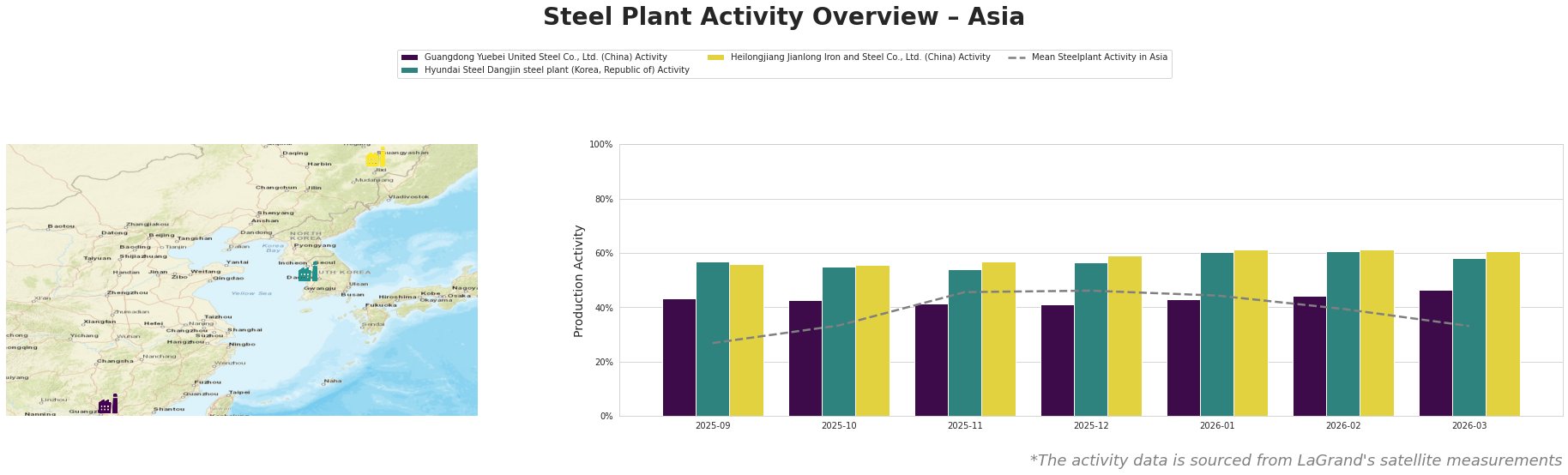
Activity at Guangdong Yuebei United Steel Co., Ltd. showed fluctuations from 43% in September 2025 to 46% in March 2026, reflecting a recent increase despite the negative news surrounding China’s output reduction. This aligns with the declining trend in total exports noted in the article “China reduced its steel exports by 8.1% y/y in January-February,” and suggests some degree of adjustment to local demand.
Hyundai Steel Dangjin experienced a stable operation level above the mean activity of 54% through early 2026 before a slight drop to 58% in March, indicating resilience against import reductions in the U.S. as mentioned in the article “The US reduced its imports of rolled steel by 45.9% y/y in January.” However, the stability contrasts with market uncertainties surrounding demand fluctuations.
Heilongjiang Jianlong reported consistent activity levels, peaking at 61% in both February and March 2026, aligning with the overall export decline trend as discussed in the “China reduced its steel output by 3.6% y/y in January–February” article. This suggests potential resilience amid the broader contractions observed in production.
Potential supply disruptions are evident, particularly from China, where reduced output and stringent export regulations are affecting availability. Steel buyers should prioritize local supply sources and consider the steady production of companies like Guangdong Yuebei and Hyundai Steel for procurement actions. Given their operational stability, placing orders promptly may mitigate risks associated with offshore sourcing disruptions tied to Chinese export policies and overall market sentiment uncertainties.