


From the Field to the Dashboard – Built by Experts, for Experts.
Discover What's Really Happening in the Steel Industry
Use the AI-powered search engine to analyze production activity, market trends, and news faster than ever before.
Try the Free AI Search EngineEuropean Steel Market Faces Supply Shock Amid New Quota Regulations
The European steel market is currently navigating a negative sentiment driven by strict new import quotas, particularly impacting Italy. Key news articles, notably “EU quota allocation stuns Italian roll buyers and importers“ and “EU quota allocations stun Italian coil buyers, importers,” highlight the challenges of reduced supply from non-EU countries, which is exacerbating sourcing difficulties and leading to anticipated price increases. These developments correlate with observable drops in activity levels at several steel plants.
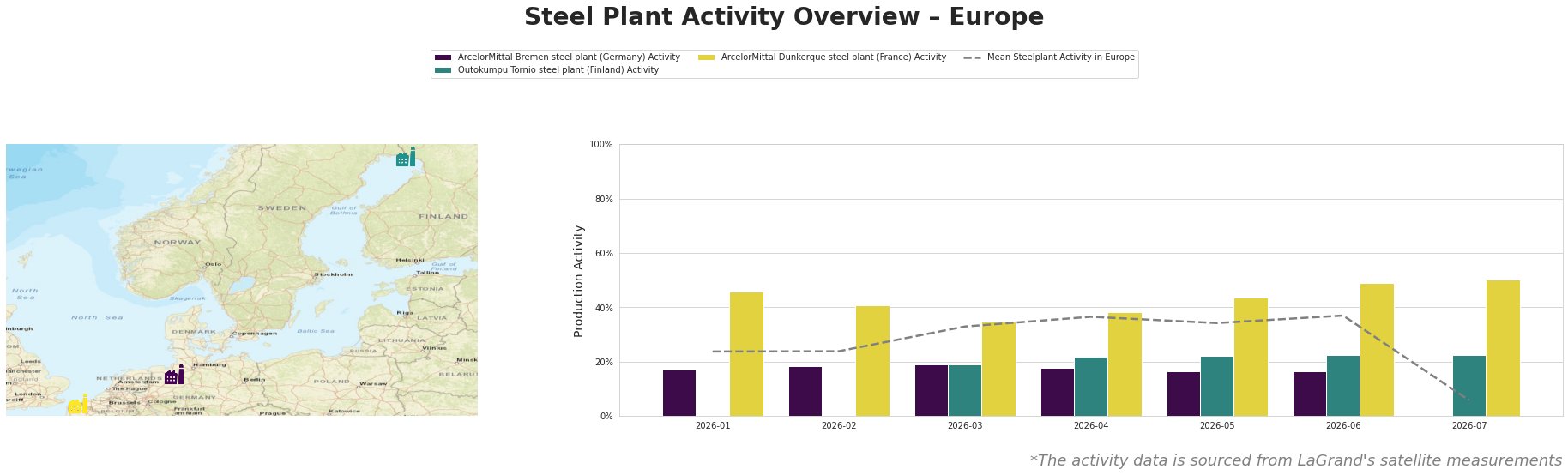
Recent activity trends indicate a significant decline in mean steel plant activity, plummeting to 6.0% in July from a peak of 37.0% in June 2026. Notably, the ArcelorMittal Bremen plant saw its activity stagnate at 16.0% in June, correlating with rising market uncertainties stemming from the new EU quotas regarding hot-rolled coil (HRC) and cold-rolled coil (CRC) imports, as discussed in “Some European suppliers withdraw from flat steel market after import quota announcements.” No direct connection could be established for the Outokumpu Tornio plant, as its activity remained stable relative to the dramatic drops observed in the overall market.
The ArcelorMittal Dunkerque plant, with its integrated production capacity of 6,750 tonnes, recorded a rise in activity to 50.0% by July 2026, indicating a potential production shift in response to domestic demand as import constraints tighten, validated by the reported price increases for HRC up to €750 per tonne by Q4.
Given the stringent EU regulations and the predicted inflation of steel prices, procurement teams should prioritize sourcing from domestic producers, particularly those like ArcelorMittal Dunkerque, whose output is expected to help alleviate supply pressures. Buyers are advised to consider securing contracts directly with local manufacturers to navigate the intended reductions in supply from non-EU sources. Delays in sourcing from Asia, necessitated by the quota constraints, suggest that securing supply now could mitigate future disruptions and stabilize costs amidst a highly volatile market.