


From the Field to the Dashboard – Built by Experts, for Experts.
Discover What's Really Happening in the Steel Industry
Use the AI-powered search engine to analyze production activity, market trends, and news faster than ever before.
Try the Free AI Search EngineEurope Steel Market Report: Mixed Activity Levels Highlights Neutral Sentiment
In Europe, recent developments in the steel market have resulted in a neutral sentiment characterized by fluctuating production levels across key regions. Significant changes in plant activity are reflected in articles such as “German crude steel output up 8.8 percent in Jan-May 2026” and “Italian crude steel production up 3.1 percent in May 2026”, which showcase growth in production. Concurrently, “Ukraine increased exports of semi-finished products by 41.6% m/m in May” suggests a resurgent export market, though activity levels remain uneven in some plants.
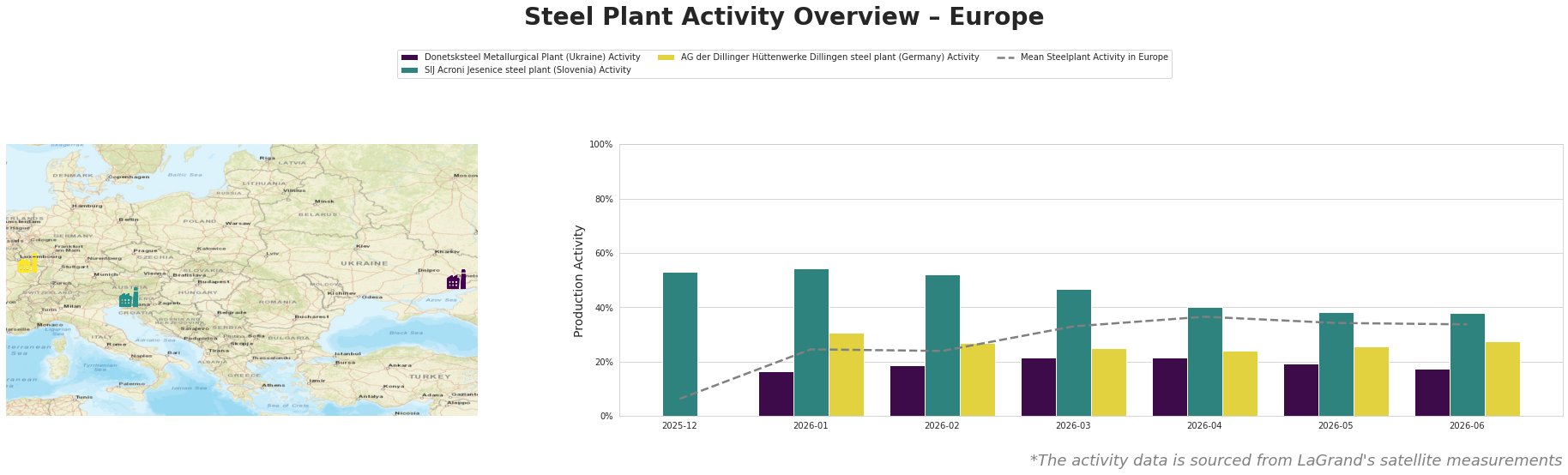
The observed data illustrates that the Donetsksteel Metallurgical Plant in Ukraine has noted a steady decline in activity from 21% in April to 17% in June 2026, although Ukraine’s overall exports surged. This disconnection suggests that while exports are increasing, local production may still face operational constraints or inefficiencies. As reported in the “Global steel production fell by 0.3% y/y in May”, the regional market continues to face challenges.
Conversely, SIJ Acroni Jesenice has maintained stable activity levels around 38-54% but recently saw a slight decrease towards the latter half of the observed months. The production for flat-rolled and coated products remains vital for sectors like building and machinery, but with stable volume, procurement considerations may tilt towards finding competitive pricing due to the potential flooding of the market with semi-finished goods.
The AG der Dillinger Hüttenwerke in Germany experienced a renewed push towards output, noted by an uptick in activity to 28% in June, though it’s still below optimal levels for complete capacity utilization as indicated in the “German crude steel production maintained its growth in May” report.
Given the current market dynamics, steel procurement professionals should focus on:
- Identify strategic suppliers from regions celebrating growth, such as Germany, where production output shows a consistent upward trend.
- Monitor Ukrainian semi-finished goods closely as exports increase, which could signify an opportunity for procurement at competitive rates despite local operational issues at specific plants.
- Balance procurement strategies with a keen eye on inventory levels and market fluctuations while observing the shifts of individual steel plants, which may reflect overall regional demand versus supply capabilities.
This nuanced approach will enable buyers to better navigate the mixed signals currently reflected in the European steel market.