


From the Field to the Dashboard – Built by Experts, for Experts.
Discover What's Really Happening in the Steel Industry
Use the AI-powered search engine to analyze production activity, market trends, and news faster than ever before.
Try the Free AI Search EnginePositive Outlook for Asia’s Steel Market: Activity Insights and Strategic Procurement Recommendations
Recent data highlights a positive momentum within the steel market in Asia, particularly driven by increasing industrial output. Specifically, “Industrial output of China’s steel sector up 1.8 percent in Jan-May 2026“ indicates a notable recovery, despite challenges facing China’s property market. The ongoing decline in real estate investments, as reflected in both “Investment in Chinese property fell by 16.2 percent y/y in January–May” and “China’s real estate investments fall further in Jan-May 2026, new construction down 22.6%“, is directly influencing a shift in consumption patterns for steel. Despite reduced steel production by 3.9% year-on-year, as reported in the first article, May data reveals a resilient growth in industrial output, suggesting that manufacturers may increasingly seek operational efficiencies.
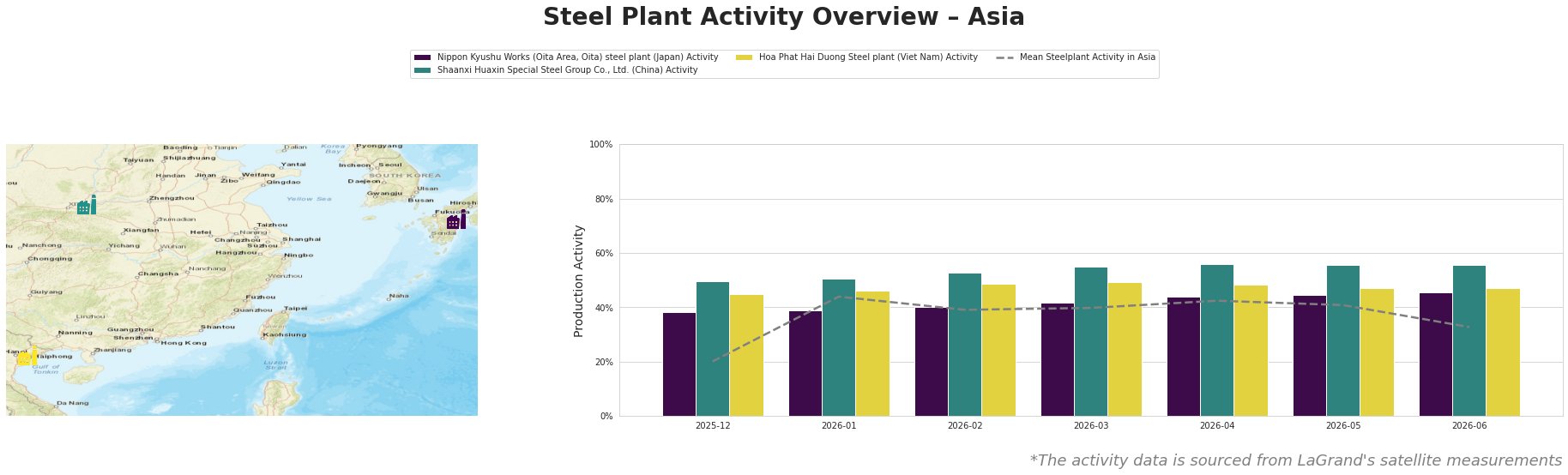
Nippon Kyushu Works (Oita Area, Oita) demonstrated stable activity levels, peaking at 45.0% in May before a decrease in June to 33.0%. The gradual rise in early 2026 coincides with the strengthening industrial output mentioned in the related news articles, indicating resilience despite market uncertainties.
Shaanxi Huaxin Special Steel Group Co., Ltd. maintained relatively high levels of activity, consistently around 55.0%, with no significant fluctuations. This steady production aligns with the sector’s overall growth trajectory, reflecting that demand persists despite the declines in new construction.
Hoa Phat Hai Duong Steel plant showed a peak in activity at 49.0% but has seen fluctuations between 45% and 47%, suggesting that while operational efficiencies are being sought, some impact from the declining construction sector is present. Particularly, the shift in steel consumption within the construction industry, falling to 49% of total consumption, may be driving strategic adjustments at this plant.
Given the trends identified, potential supply disruptions could arise, notably from plants like Nippon Kyushu Works where activity has shown fluctuations, warranting closer procurement oversight. Steel buyers should prioritize sourcing from steel plants with demonstrated stability, such as Shaanxi Huaxin Special Steel, to mitigate risks.
For procurement professionals, it is advisable to increase inventory reserves for hot-rolled steel products, especially given potential price fluctuations amidst reduced exports, indicated by “China’s steel sheet/plate exports down 13.9 percent in January-May 2026.” Buyers should engage strategically, with an emphasis on timely negotiations and securing bulk orders from plants demonstrating consistent production output.