


From the Field to the Dashboard – Built by Experts, for Experts.
Discover What's Really Happening in the Steel Industry
Use the AI-powered search engine to analyze production activity, market trends, and news faster than ever before.
Try the Free AI Search EngineAsia Steel Market Insights: Production Declines and Emerging Trends Amid Price Stability
China’s steel production has seen a significant decline as highlighted by “China reduced steel output by 3.9% y/y in January–May“ and “China’s crude steel output down 3.9 percent in January-May 2026, slight rebound in May“. This downturn is attributed to reduced domestic demand stemming from a struggling real estate sector, where investment in property fell by 16.2% year-on-year as per the article “Investment in Chinese property fell by 16.2 per cent y/y in January–May.” Satellite data reflects these trends, with notable activity shifts among steel plants in the region.
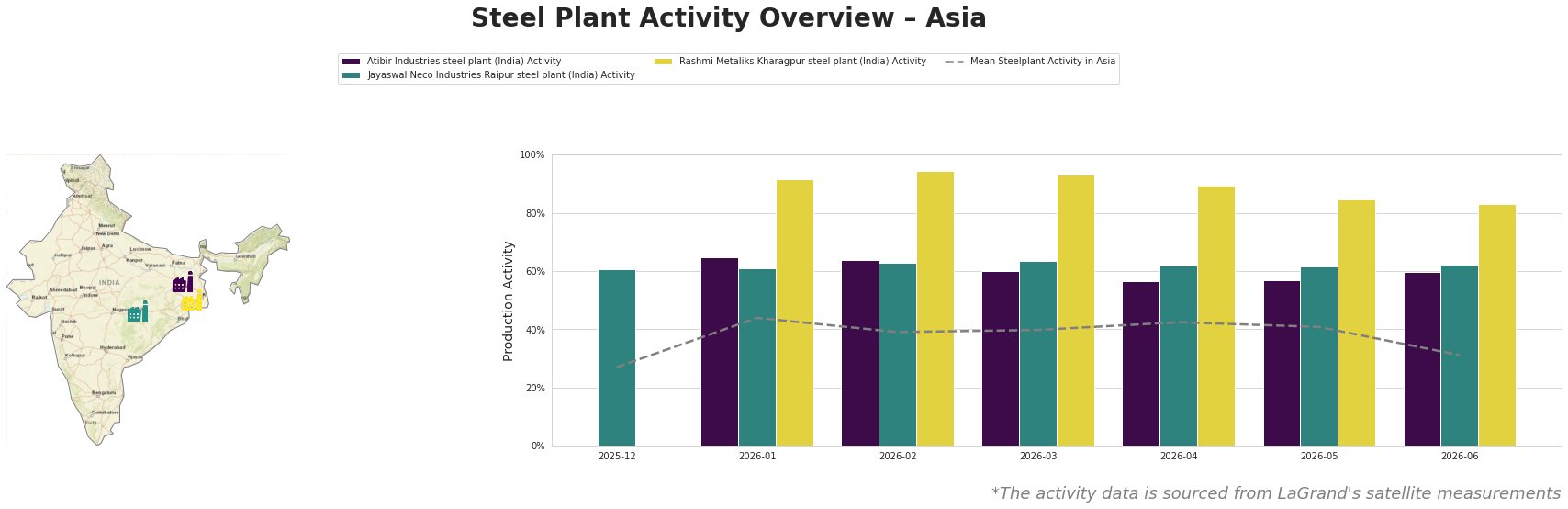
The data indicates a maximum activity peak in January for the Jayaswal Neco Industries Raipur steel plant at 92.0%, aligning with seasonal demand patterns. Activity at Rashmi Metaliks peaked in February at 95.0%, suggesting strong output that has since declined. Notably, in June, the mean activity level dropped to 31.0%, reflecting a general slowdown. This corresponds with “CISA mills’ daily crude steel output up 3.8% in early June 2026, stocks also up,” where increased inventories signal an imbalance due to weaker demand during the traditional off-peak season.
Atibir Industries, based in Jharkhand, operates with integrated production focusing on crude and rolled steel. While its activity fell from 65.0% in January to a low of 56.0% in April, it stabilized slightly to 60.0% in June. This fluctuation aligns with data showing the seasonal nature of demand driven by construction activities, indicated by decreasing investment trends in real estate.
Jayaswal Neco in Chhattisgarh has shown more stable production levels, maintaining an average activity range of 61-64% over the past six months. However, the plant’s possible procurement from sectors heavily impacted by the real estate downturn could necessitate strategic adjustments as market demand decreases.
Rashmi Metaliks, with significant capacity for crude steel and a heavy reliance on direct reduced iron, witnessed one of the sharpest declines, falling from 95.0% in February to 83.0% in June. This shift may be a direct consequence of challenges facing the broader construction sector, detailed in “China’s real estate investments fall further in Jan-May 2026, new construction down 22.6%.”
Given the declining trend in crude steel production amid rising inventories, steel buyers should carefully evaluate procurement strategies. It is advisable to consider contracting with Jayaswal Neco or Atibir Industries, where activity levels show potential for recovery with adjusted operational strategies. Monitoring the ongoing shifts in construction demand will be crucial for making informed purchasing decisions. Additionally, maintaining flexibility in inventory management could mitigate supply disruption risks as the facilities adjust to changing demand dynamics.