


From the Field to the Dashboard – Built by Experts, for Experts.
Discover What's Really Happening in the Steel Industry
Use the AI-powered search engine to analyze production activity, market trends, and news faster than ever before.
Try the Free AI Search EngineSouth Korea’s Steel Market Outlook: POSCO and Hyundai Lead Charge in Low-Carbon Innovation
South Korea’s steel industry is experiencing a significant upswing in activity, primarily driven by substantial investments from leading players. Recent developments highlighted in “POSCO and Hyundai Motor join forces to develop next-generation electrical steel” have strengthened the integration of steel and automotive sectors, promoting innovations in electrical steel. Concurrently, “POSCO is launching South Korea’s largest electric arc furnace” indicates a shift towards low-carbon production methods, aligning with heightened environmental regulations, marking a transformative phase for the industry.
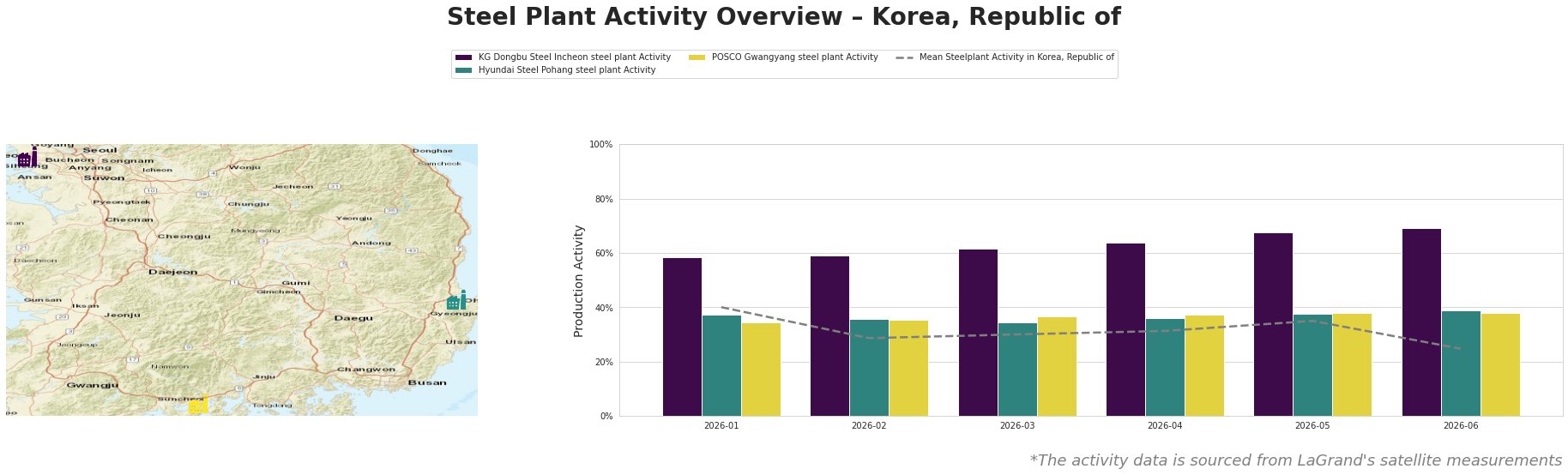
The satellite data reveals notable trends: activity at KG Dongbu Steel Incheon peaked at 69% in June 2026, up from 59% in January, while Hyundai Steel Pohang also increased to 39%. However, the mean activity has fluctuated, notably dropping to 25% in June after a peak at 35% in May, indicating potential volatility in demand. No direct connections were established between these activity trends and the news articles discussed.
KG Dongbu Steel Incheon, primarily operating EAF technology, supports various semi-finished and rolled steel products, witnessing a strong rise in activity (up to 69% in June). This surge likely reflects broader demand dynamics rather than specific project ties. Hyundai Steel Pohang, with a capacity of 3.2 million tonnes, has also seen increased production activity but with no definitive connections to the recent innovations involving POSCO and Hyundai collaborations. The POSCO Gwangyang steel plant has maintained stable activity of 38%, though it is crucial to note that the increased focus on EAF processes through recent investments could indicate shifting priorities towards sustainable steel production.
Moving forward, steel buyers should prioritize procurement from KG Dongbu Steel and Hyundai Steel as they ramp up production capabilities —with the latter also expected to integrate more EAF technology following POSCO’s advancements. The imminent full-scale production from POSCO’s new EAF facility and commitments to low-carbon steel suggest potential supply stability and lower emissions-product offerings.
In conclusion, action should be taken to engage with suppliers like POSCO Gwangyang for low-carbon steel options, and monitor the evolving capacity and output levels in response to collaborative automotive technology developments. Steel buyers should leverage these insights to secure advantageous procurement strategies in anticipation of potential shifts in supply dynamics.