


From the Field to the Dashboard – Built by Experts, for Experts.
Discover What's Really Happening in the Steel Industry
Use the AI-powered search engine to analyze production activity, market trends, and news faster than ever before.
Try the Free AI Search EnginePositive Outlook for Asia’s Steel Market Amid Changes in Production and Demand
In Asia, a predominantly positive market sentiment is bolstered by recent developments affecting steel production and consumption. Reports such as “Steel shipments to the US fell by 6.6% m/m in April“ highlight shifting dynamics in global steel trade that may influence Asian exporters. Concurrently, “China reduced steel output by 3.9% y/y in January–May“ correlates with observed increases in satellite-measured activity at certain steel plants, indicating potential recovery in local demand.
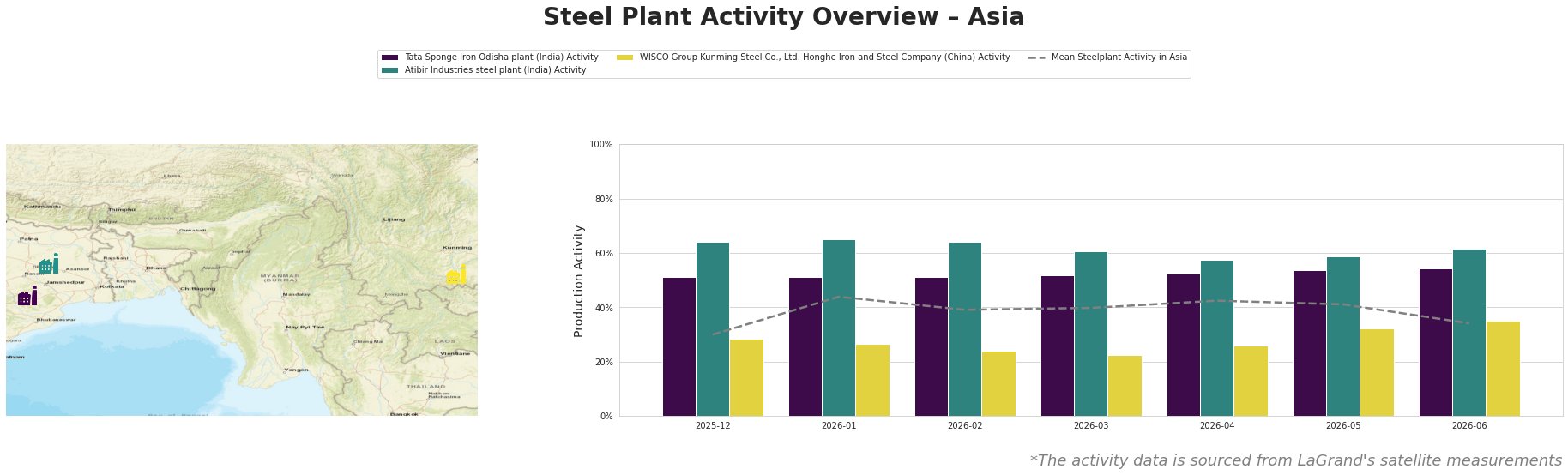
The Tata Sponge Iron Odisha plant maintained solid activity levels, peaking at 54% by May 2026. This stable performance aligns with rising steel consumption forecasts in India, where “Steel production in India could rise by 8% y/y in the FY2026/2027 – forecast“ indicates growth driven by public sector projects. While there is no direct correlation established between activities at Tata and the article, the overall market confidence points to a supportive environment for demand.
Atibir Industries demonstrated a notable steadiness with activity peaking at 65% in January. Although corresponding news articles do not specifically address Jharkhand, the broader context of increased project execution supports robust consumption.
Conversely, WISCO Group’s activity remains relatively lower, moving between 22% and 32% over the observed periods. Recent articles, such as “China’s crude steel output down 3.9 percent in January-May 2026, slight rebound in May,” explain the cautious production environment affecting demand for steel products and may reflect the observed dip. However, the slight uptrend in early June could suggest recovery dynamics, motivating buyers to monitor inventory levels.
In summary, potential supply disruptions may arise from the ongoing adjustments in China’s production levels impacting global supply chains. Steel buyers should strategically enhance inventories at Indian facilities, given anticipated production increases in the region. Conversely, caution should be exercised in sourcing from WISCO Group’s facility, where lower output levels and rising inventories indicate subdued demand amid regional climatic challenges. Explicit procurement strategies should adapt to capitalise on improving production dynamics while mitigating risks from fluctuations in Chinese markets.