


From the Field to the Dashboard – Built by Experts, for Experts.
Discover What's Really Happening in the Steel Industry
Use the AI-powered search engine to analyze production activity, market trends, and news faster than ever before.
Try the Free AI Search EngineEuropean Steel Market Report: Tata Steel’s Port Talbot Fire Signals Supply Risks and Price Pressures
The European steel market faces negative sentiment driven by operational disruptions at the Tata Steel Port Talbot facility in the UK. Specific incidents reported in A fire broke out at a Tata plant in the UK and Tata Steel’s Port Talbot site hit by processing‑line fire highlight significant activities affecting production capacity, leading to potential supply chain challenges. The fire led to the temporary shutdown of critical processes, notably in hot rolling and pickling, restricting output just as the market braces for upcoming UK steel safeguard measures.
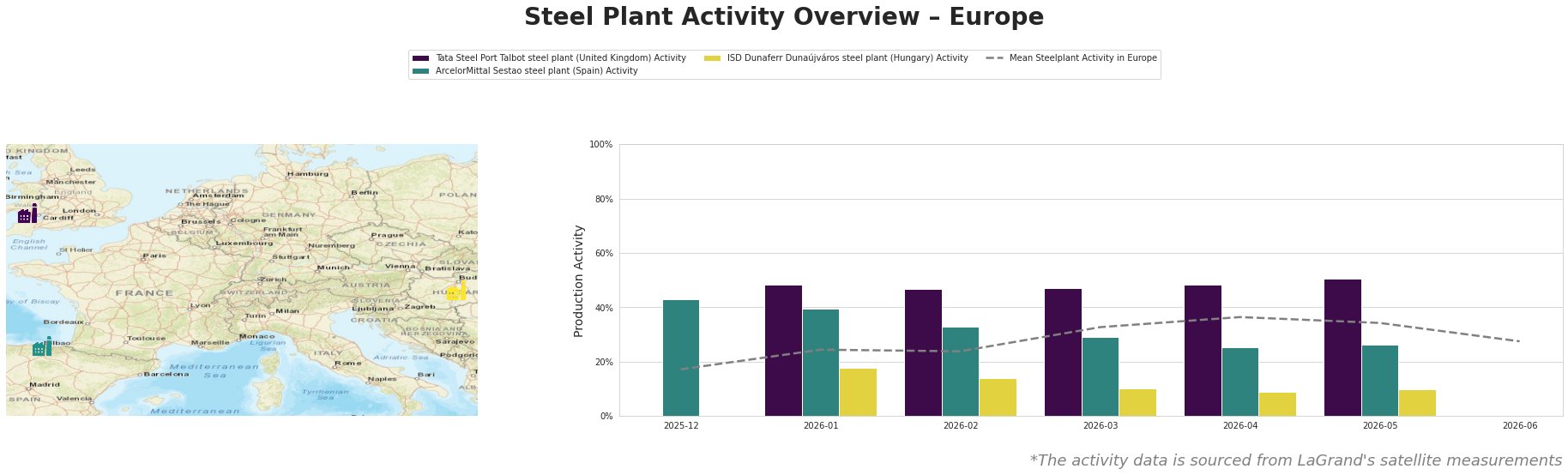
Tata Steel’s activity level saw a peak of 50% in May, closely preceding the June fire. Following the fire on June 3, operations at Port Talbot have faced uncertainty, which may lead to further declines. ArcelorMittal Sestao and ISD Dunaferr’s activity remains significantly lower, indicating a potential oversupply and softer market conditions. Notably, the ArcelorMittal Sestao plant, which operates purely on electric arc furnace technology, exhibited diminished activity levels in April and May, hinting at broader economic impacts rather than localized issues.
Tata Steel’s Port Talbot plant, an integrated facility focusing on mechanical rolling of both semi-finished and finished products, faced a drop in operational resilience after the recent fire, as reported in Fire hits Tata Steel UK’s Port Talbot pickling line. Despite a previously robust performance, where it accounted for 50% activity in May, the anticipated disruptions raise considerable concerns about supply continuity for hot rolled and galvanized products, especially with deliveries projected to fall amidst subdued demand trends. Current output and repair efforts could result in delays, further complicating procurement for buyers dependent on their products.
ArcelorMittal Sestao, with a capacity focused on electric arc furnace production, maintained moderate activity levels, yet potential repercussions from Tata Steel’s disruptions could shift market dynamics, especially in the automotive and construction sectors reliant on competitive pricing and timely delivery of hot-rolled coils. ISD Dunaferr’s considerably low activity should be monitored as disruption at Tata could potentially shift demand to their limited output.
To mitigate risks, steel buyers should anticipate possible supply shortages and consider diversifying sourcing strategies to include suppliers like ISD Dunaferr, despite its low activity levels. Immediate procurement planning is crucial, particularly in preparation for continued upward pressure on prices, as noted in the fire emphasized the risks of depending on single sources for steel supply aligned with the increased hot-rolled coil prices seen in the broader market context. Engaging with suppliers ahead of time could facilitate better pricing and availability as market conditions evolve.