


From the Field to the Dashboard – Built by Experts, for Experts.
Discover What's Really Happening in the Steel Industry
Use the AI-powered search engine to analyze production activity, market trends, and news faster than ever before.
Try the Free AI Search EnginePositive Momentum in European Steel: Strategic Insights for Buyers Amid Regulatory Changes and Market Growth
In Europe, a very positive sentiment surrounds the steel market fueled by developments outlined in the article EU debates steel measures’ downstream coverage, Ukraine support and insights from One question ran through EUROMETAL’s Helsinki meeting: who pays for the green transition — and who acts?. Recent activities at several key steel plants indicate robust production trends that align with evolving regulations and potential increases in demand.
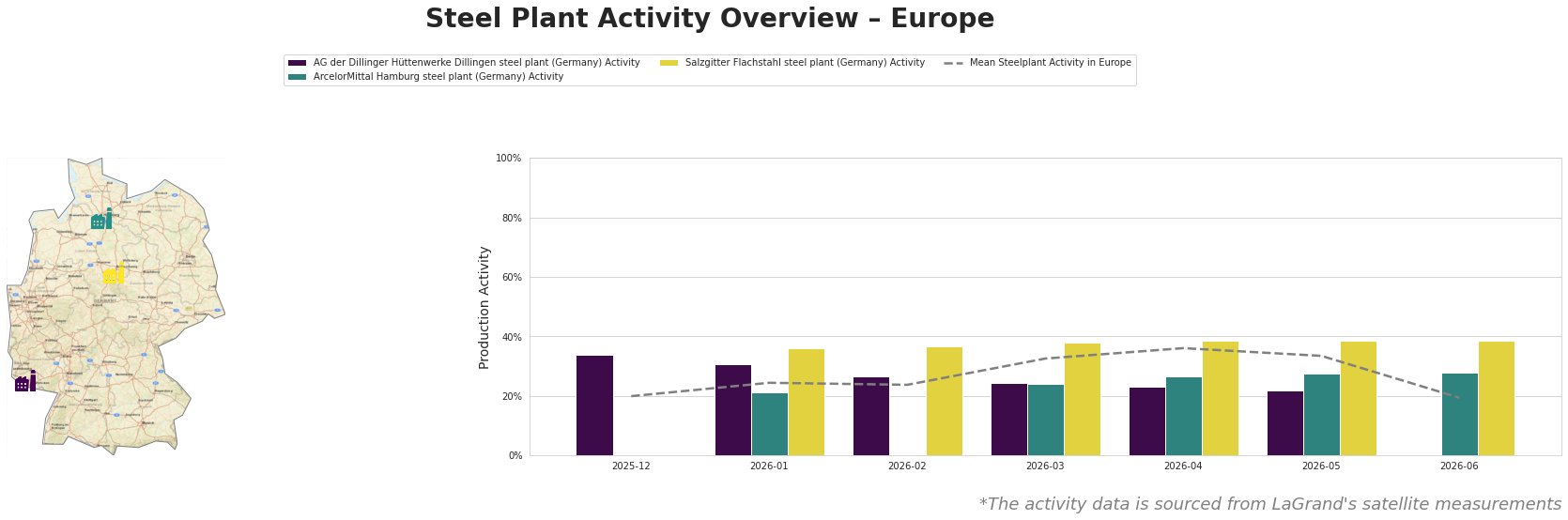
The satellite observation data shows that the AG der Dillinger Hüttenwerke in Saarland experienced a notable decline in May (22%) after maintaining a higher activity level of 34% in December and mid-30s at the beginning of the year. This decline, along with a jump to 34% at the end of December, aligns with ongoing discussions in the EU regarding broader coverage of steel measures (as mentioned in EU debates steel measures’ downstream coverage, Ukraine support), which may influence production decisions in anticipation of regulatory changes.
The ArcelorMittal Hamburg steel plant demonstrated stable activity, peaking at 36% in January but exhibiting a recent increase to 28% by June. The commentary in the EUROMETAL meeting emphasizes the industry’s cautious optimism regarding investments in green transitions, which could drive demand for products produced at this facility, particularly for sectors like automotive and construction.
The Salzgitter Flachstahl steel plant has shown a consistent uptick in activity, peaking at 39% in both April and June, possibly reflecting strong market demand amid the new steel trade regime discussions, which aim to protect local industries while promoting innovation toward lower CO2 emissions. This aligns with evolving regulations and suggestions made in One question ran through EUROMETAL’s Helsinki meeting: who pays for the green transition — and who acts?.
Given these dynamics, steel buyers should actively monitor regulatory developments, particularly those pertaining to the EU’s steel safeguard regime set to be adopted by July 1, as indicated in the cited news articles. The noted peaks and valleys in plant activities suggest strategic procurement opportunities, particularly from those improving or maintaining high production rates, such as Salzgitter, with potential emphasis on environmentally friendly steel from plants adapting to new requirements.
In conclusion, suppliers may face fluctuations related to these regulatory changes, especially impacting German plants like AG der Dillinger. Strategic sourcing decisions should therefore consider immediate procurement from higher-activity plants in response to potential supply disruptions as the industry adjusts to the evolving landscape.