


From the Field to the Dashboard – Built by Experts, for Experts.
Discover What's Really Happening in the Steel Industry
Use the AI-powered search engine to analyze production activity, market trends, and news faster than ever before.
Try the Free AI Search EngineEurope’s Steel Market Outlook: Positive Trends Amidst Supply Tightening Dynamics
In Europe, the steel market exhibits a very positive sentiment, marked by recent developments that impact both supply and demand dynamics. Notably, “Ukraine saw a 55% y/y decline in long-product exports in January–April” and “Ukraine increased imports of long steel products by 56.6% y/y in January–April“, pointing towards significant shifts in export-import balances that may affect pricing and availability across the region. Changes in satellite-observed activity at key steel plants further illustrate these trends, revealing evolving capacity utilization patterns.
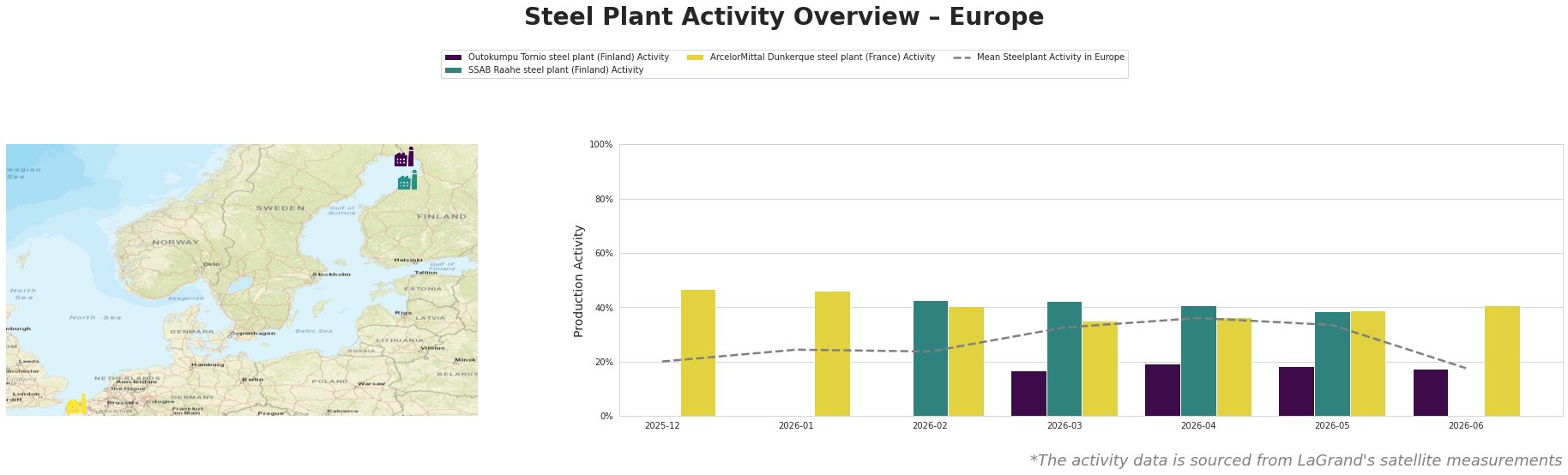
The Outokumpu Tornio steel plant in Finland exhibited a gradual improvement with activity levels rising to 19% in April 2026 after an initial dip earlier in the year, indicating resilience. However, by June, the activity fell to 18%, showing a potential misalignment with increasing import demands as per the news that “Ukraine increased imports of long steel products by 56.6% y/y in January–April.” This suggests that while domestic consumption may strengthen, import reliance is becoming more pronounced.
The SSAB Raahe steel plant showed stable operations with activity levels consistent around 41% through April but saw a slight decline in May to 39%. Given that “Ukraine’s long-product exports decreased significantly,” it may indicate a regional supply tightening that could benefit domestic production, assuming steady or rising demand.
The ArcelorMittal Dunkerque steel plant maintained relatively high activity levels of 39% in May before a notable drop in June to 41%. This plant’s ability to adapt to fluctuations may be critical in light of supply issues stemming from Ukrainian export declines, as suppliers may need to pivot toward producers with reliable capacity.
Given the potential supply disruptions indicated by declining exports from Ukraine, steel buyers should consider:
1. Prioritizing purchases from local producers like SSAB Raahe and ArcelorMittal Dunkerque whose operational data shows responsiveness to market changes.
2. Monitoring volumes closely, particularly from Turkey following its 18.4% decrease in HRC exports, to avoid over-reliance on fluctuating overseas supplies.
3. Engaging with suppliers to secure short-term contracts amidst tightening supplies, particularly where observed activity levels show vulnerability, such as at Outokumpu.
Strategically, leveraging domestic production capabilities in response to external supply shocks can safeguard procurement strategies for steel buyers in Europe.