


From the Field to the Dashboard – Built by Experts, for Experts.
Discover What's Really Happening in the Steel Industry
Use the AI-powered search engine to analyze production activity, market trends, and news faster than ever before.
Try the Free AI Search EngineNegative Trends in Oceania’s Steel Market: Activity Declines Amid Decarbonization Cutbacks
The steel market in Oceania exhibits a negative sentiment, largely attributed to BHP is scaling back decarbonization projects at its iron ore operations – media reports and BHP has abandoned a number of projects to decarbonize the iron ore business. These decisions reflect declining activity levels across several steel plants, particularly as BHP adjusts its commitments in response to rising costs and economic challenges.
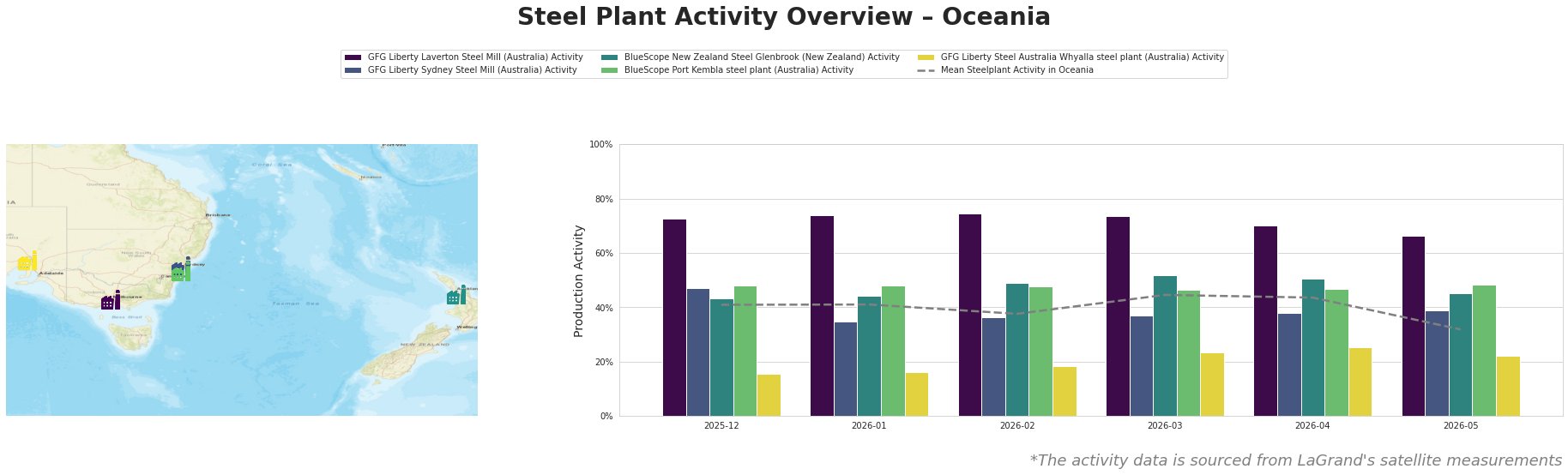
Activity levels at GFG Liberty Laverton Steel Mill remained stable above the mean throughout late 2025, peaking at 75% in February 2026 but dropped to 66% by May. The decline aligns with concerns raised in BHP scraps Pilbara iron ore decarbonization project amid rising costs and weak economics, indicating a collective hesitance in the market. The GFG Liberty Sydney Steel Mill followed a similar pattern, with a decrease to 39% in May from a higher rate in previous months, suggesting a weakened demand or operational issues.
BlueScope New Zealand Steel Glenbrook and BlueScope Port Kembla exhibit moderate fluctuations, correlating with broader market hesitance but not strongly linked to specific events. Yet, BlueScope’s Glenbrook plant’s rise to 52% in March indicates some isolated stability in product demand. Meanwhile, GFG Liberty Steel Australia Whyalla Steel Plant faced significant challenges, with activity hovering around 16% to 25%, signaling potential supply disruptions tied to its inability to adapt to evolving economic conditions.
In light of these trends, steel buyers and market analysts should consider:
1. Securing Contracts Early: As reported projects like BHP is scaling back decarbonization projects at its iron ore operations introduce uncertainty, long-term agreements may mitigate risks of supply shortfalls.
2. Diversifying Supply Sources: With substantial dips, particularly in GFG Liberty Australia Whyalla steel plant’s performance, buyers may want to explore additional suppliers to ensure steady material flow.
3. Monitoring Production Changes: Keeping a close watch on production figures following the announced decarbonization cuts can equip buyers to adjust inventory strategies accordingly.
Active engagement with stakeholders and continuous monitoring of market signals will be essential for navigating this challenging landscape.