


From the Field to the Dashboard – Built by Experts, for Experts.
Discover What's Really Happening in the Steel Industry
Use the AI-powered search engine to analyze production activity, market trends, and news faster than ever before.
Try the Free AI Search EngineAsia’s Steel Market: Positive Sentiment Boosted by Plant Activity and Strategic Acquisitions
Steel market activity in Asia remains robust, driven by strategic developments and increased functionality in major steel plants. The recent news article titled Administrators relaunch Galati sale tender for 19 June explicitly correlates to market activity, highlighting a renewed interest in the Romanian steel market that could influence regional dynamics. The tender for the Liberty Galati plant underscores significant impending changes in capacity and ownership that could ripple through adjacent markets.
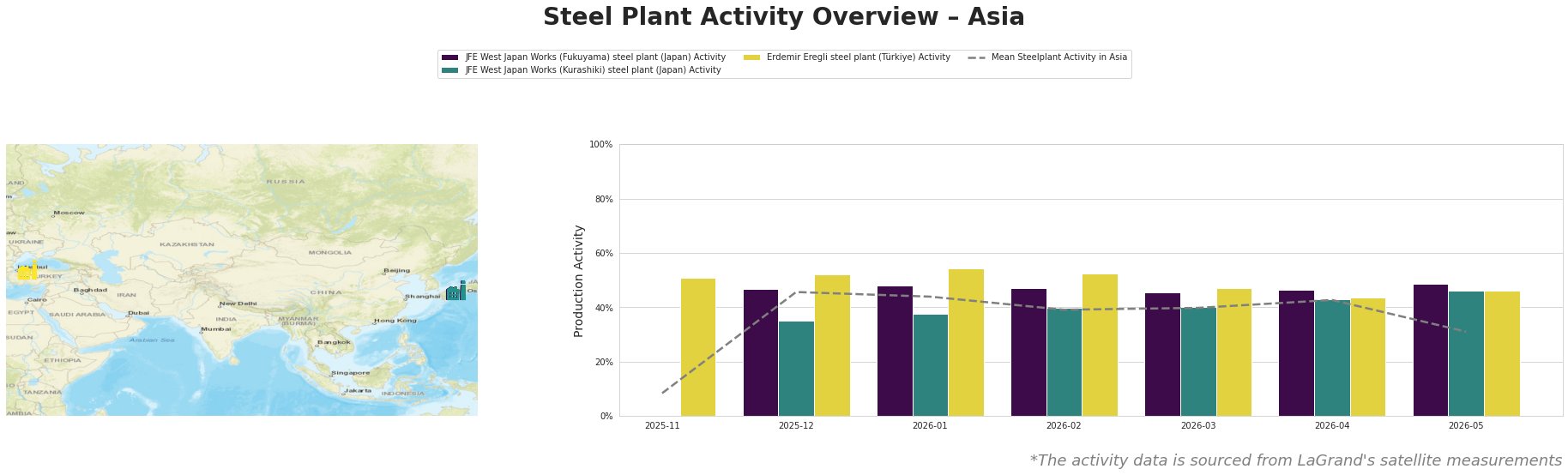
The JFE West Japan Works (Fukuyama) steel plant demonstrated noteworthy activity, reaching 49.0% in May 2026, reflecting a significant uptick in operations leading up to the tender announcement for Liberty Galati, which could foreseeably increase demand for Japanese steel products. Similarly, JFE West Japan Works (Kurashiki) also exhibited a stable operating rate around 46.0%. In contrast, the Erdemir Eregli plant maintained an operational level of 46.0%, consistent with market demand but showing slight fluctuations that do not have direct ties to recent news.
These activity levels suggest regional stability in production, although no explicit connections to the Galati auction can be established for the Turkish plant. However, heightened interest and potential changes in European steel dynamics could indirectly influence procurement strategies across Asia.
In terms of strategic insights, steel buyers should prepare for potential supply fluctuations stemming from the outcomes of the Liberty Galati tender. With the plant possessing significant production capacity and specialized equipment for hot and cold rolling, successful acquisition could redirect market flows and demand dynamics. Steel professionals should monitor the auction closely, as the successful sale could stabilize pricing against emerging competition from enhanced European capacities.
In conclusion, amid a very positive sentiment, procurement strategies should emphasize agility to adapt to changes, particularly following pivotal transactional outcomes. This heightened awareness will enhance preparedness for potential supply chain disruptions arising from shifting operational capacities across key steel plants in the region.