


From the Field to the Dashboard – Built by Experts, for Experts.
Discover What's Really Happening in the Steel Industry
Use the AI-powered search engine to analyze production activity, market trends, and news faster than ever before.
Try the Free AI Search EngineBrazil’s Steel Market: Neutral Sentiment Amid Fluctuating Activity and Mixed Trade Signals
In Brazil, recent activity in the steel sector reflects a Neutral market sentiment driven by fluctuations in both domestic production and international trade dynamics. The articles “Brazil’s finished steel trade deficit narrows on antidumping measures” (2026-05-22) and “In April Brazil rebar exports rise on stronger shipments to South America, while imports fell on no Egyptian supply” (2026-05-20) indicate a potential stabilization in trade balances. However, satellite-observed activity data shows variability in steel plant performance correlating with these trends.
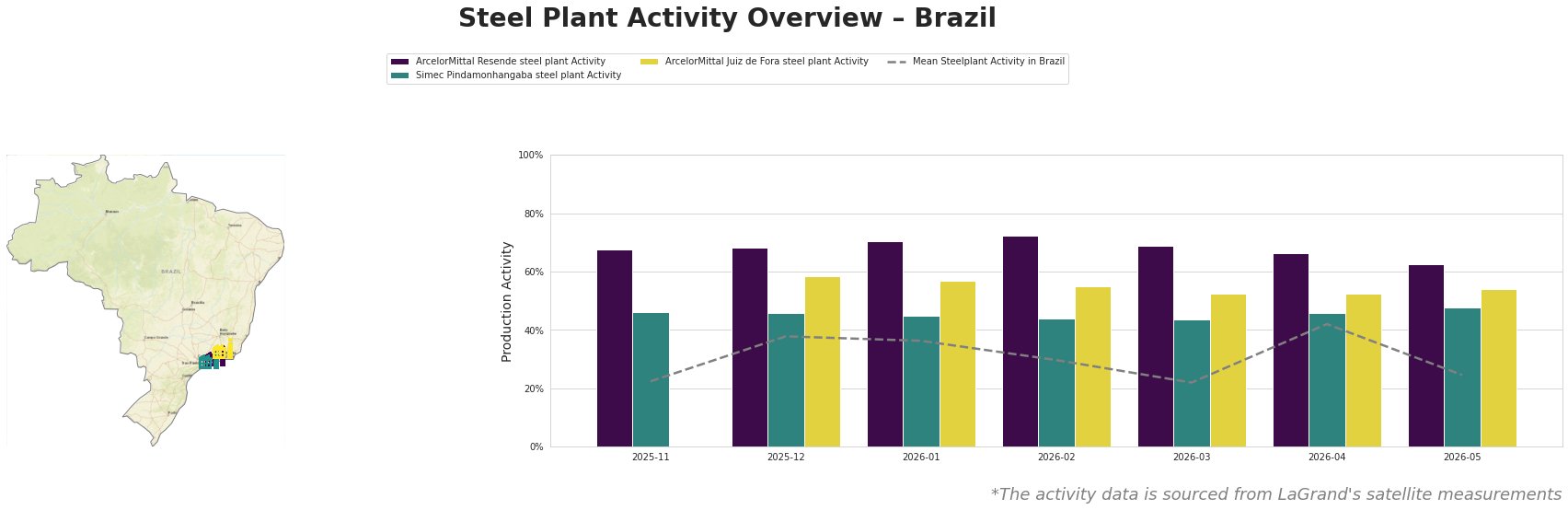
The ArcelorMittal Resende plant observed a decline from 72.0% in February to 63.0% in May, reflecting broader market pressures and possibly linked to decreased competition from imports, as indicated by the reduction in China and South Korean shipments. Conversely, Simec Pindamonhangaba’s activity peaked at 48.0% in May, although this remains below its previous activity in December, indicating ongoing instability.
The ArcelorMittal Juiz de Fora plant maintained stable levels, suggesting it is less impacted by the fluctuations highlighted in trade dynamics. Notably, the “Brazilian HRC exports and imports fell in April amid drop in S. American shipments, S. Korean imports” (2026-05-21) also supports the view that strategic adjustments in exports, particularly to South America, are reshaping domestic production demands.
Notable market implications arise from these observations:
-
Supply Disruptions: Continual trade deficits may lead to pressure on certain steel plants, particularly if import conditions do not improve. ArcelorMittal Resende and Simec could face heightened strain if current trade barriers persist.
-
Procurement Recommendations: Steel buyers should prioritize sourcing rebar from Gerdau and ArcelorMittal, as both companies have shown resilience in export growth amidst shrinking imports. Additionally, considering the recent drop in hot-rolled coil imports, procurement strategies should shift towards securing contracts from local producers before potential price fluctuations or supply constraints emerge as a result of ongoing trade policies.
Continuous monitoring of steel plant activities and aligning procurement with evolving trade balances will be essential for optimizing supply chain resilience in Brazil’s steel market.