


From the Field to the Dashboard – Built by Experts, for Experts.
Discover What's Really Happening in the Steel Industry
Use the AI-powered search engine to analyze production activity, market trends, and news faster than ever before.
Try the Free AI Search EngineSteel Market Snapshot: Ukraine Faces Diminished Activity and Supply Chain Risks Amid Quota Adjustments
Ukraine’s steel industry is experiencing significant activity declines, primarily due to external geopolitical pressures and domestic policy changes. The British Chambers of Commerce warns UK steel quota changes could disrupt supply chains and Calls grow for UK steel quota revisions, highlighting the risks posed by proposed reductions in duty-free import quotas and increased tariffs on steel imports to the UK. These changes directly threaten the supply chain stability for Ukrainian steelmakers reliant on imported raw materials and export markets. While no explicit connections to satellite-observed activity data were established, ongoing low activity levels in Ukraine’s major plants indicate adverse effects.
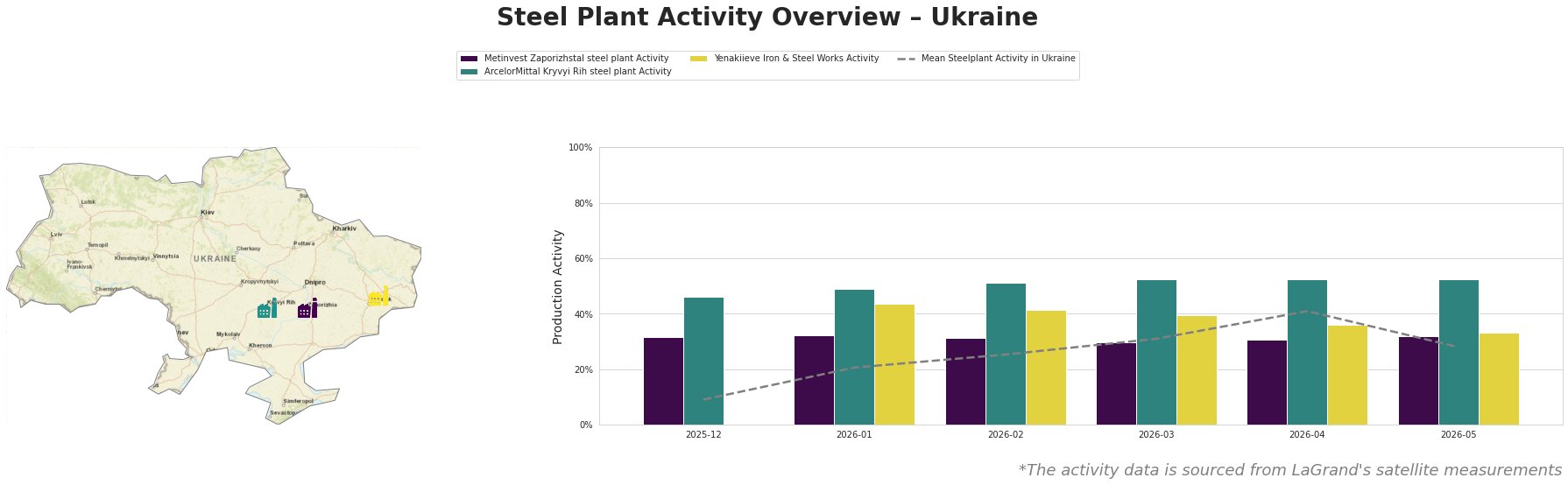
The activity levels across major Ukrainian steel plants have shown fluctuating patterns but remain noteworthy low, particularly with Mean Steelplant Activity recording a significant drop to 9.0% in December 2025 before recovering partially to 28.0% by May 2026. Notably, the ArcelorMittal Kryvyi Rih steel plant has maintained relatively higher activity levels (52.0% in May), in contrast to the Metinvest Zaporizhstal, which remained stable but below the mean with 32.0%.
Metinvest Zaporizhstal steel plant
The Metinvest Zaporizhstal plant, with a crude steel capacity of 4,100 metric tons per annum (MTPA), has exhibited little activity variance, sustaining at around 32.0% through most of 2026. This stability can be interpreted as a reaction to concerns raised by the British commerce chamber warns over steel quota damage, which indicates expected supply chain disruptions and increased costs for manufacturers that likely have cascading effects on production. Although there is no direct connection to the observed activity, the persistent lower levels highlight vulnerability when external supplies are threatened.
ArcelorMittal Kryvyi Rih steel plant
With a more substantial capacity of 8,000 MTPA and a diversified product range including semi-finished and finished rolled products, ArcelorMittal Kryvyi Rih has seen its activity maintain at 52.0%. This aligns with their robust operational strategies and less dependency on imports compared to competitors. However, current market disruptions spearheaded by BCC warns UK steel quota changes could disrupt supply chains could still pose long-term risks despite currently favorable performance.
Yenakiieve Iron & Steel Works
Yenakiieve Iron & Steel Works, with a crude steel capacity of 3,300 MTPA, presents a declining activity trend, evidenced by a drop from 49.0% in January to 33.0% in May. The absence of localized market engagement in news articles provides a context where no direct operational link has been established, though the adverse geopolitical environment undoubtedly plays a role in this decline.
The evidence highlights significant potential supply disruptions across Ukrainian steel markets, especially for procurement professionals needing to source materials for construction and manufacturing industries. Steel buyers should consider diversifying their supplier base to mitigate risks stemming from external quota adjustments and geopolitical conflicts.
Recommendation:
1. Engage alternative supplier discussions to acquire steel grades not currently produced domestically in the UK market, as the proposed quota changes threaten access to diverse materials.
2. Monitor developments in Ukrainian steel plant outputs, especially if further adjustments in tariffs occur, prompting adaptability in procurement strategies.
3. Assess long-term impacts on pricing and availability for specialized steel products, as ongoing uncertainties may compel market readjustments, particularly for the construction and engineering sectors, leading to potential price increases.