


From the Field to the Dashboard – Built by Experts, for Experts.
Discover What's Really Happening in the Steel Industry
Use the AI-powered search engine to analyze production activity, market trends, and news faster than ever before.
Try the Free AI Search EnginePositive Steel Production Trends in Europe: Italy Shows Strong Growth in April 2026
Italy’s crude steel production has demonstrated resilience and growth, marked by a 7.2% increase in April compared to the same month last year, as stated in the article “Italy’s crude steel production increased by 7.2% in April.” This uptick is backed by data from SteelRadar, which reveals total production for the first four months at 7.6 million tons, reflecting a 2.9% year-on-year increase. Furthermore, activity from satellite observations aligns with these trends, showcasing significant production output recently.
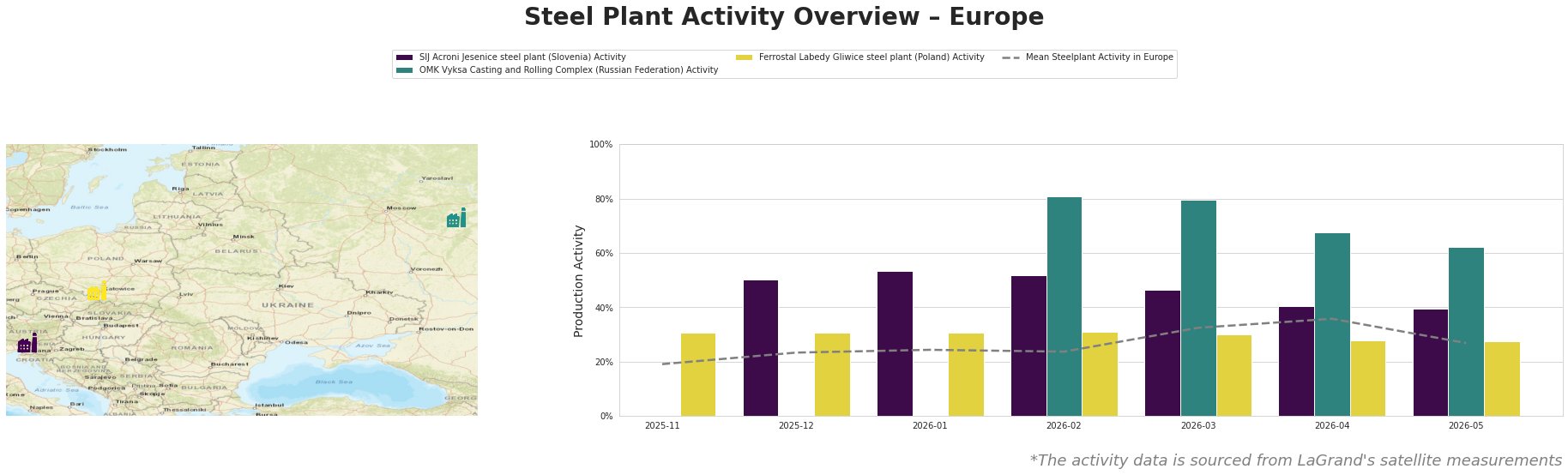
The SIJ Acroni Jesenice steel plant, with a capacity of 726,000 tons, has reported a drop to 40% activity in April, down from 47% the previous month. This decline does not seem directly linked to production changes within Italy, despite the national uptick highlighted in “Italy’s steel output up in April, longs post double-digit growth.” Conversely, the OMK Vyksa Casting and Rolling Complex in Russia maintained relatively high activity, showing 68% in April, attributed to stronger regional demands, though no immediate connections can be confirmed with the rise in Italian production.
The Ferrostal Labedy Gliwice steel plant, at 28% activity, is approaching its operational limits but reveals no immediate ties to the recovery indicated in Italy’s output increase according to the articles provided.
In light of the current positive sentiment and the situation across Italian steel production plants, supply disruptions may arise from decreased activity in the SIJ Acroni Jesenice and Ferrostal Labedy Gliwice plants. This presents an opportunity for steel buyers to prioritize procurement from regions displaying upward production trends, especially in Italy, to mitigate risks from any potential supply gaps. Engaging with suppliers actively producing long products in Italy could present advantageous contractual conditions to capitalize on the current growth trajectory in the European steel market.